
Reading the Room Before You Make Your Presence Known
An introduction to the forward-looking layer of the rDNA.ai toolkit: target-landscape whitespace and trajectory analysis over a structured, provenance-complete knowledge graph of biopharma IP — read here across the cGAS-STING, epigenetic, and TL1A target classes.
When this series paused after the ninth article, it had spent nine essays doing one thing: reading the patent record backward. Each article took a deal, a modality, or a target class that had already resolved — the antibody-drug conjugate (ADC) wave, the GLP-1 field, the KRAS inversion, the TL1A acquisitions — and showed what the structural-IP layer underneath it had been saying all along, if anyone had read it at filing time instead of at deal announcement time.
That is a useful biopharma BD&L discipline, and it is one a diligence team regularly practices. But it answers the BD&L professional’s second question, after valuation, not the inventor’s first question. The inventor does not ask “what did the last deal mean.” The inventor asks “where is there still room to build, and where is this field already headed without me.” Answering that forward-looking question, at corpus scale and with an audit trail a professional can rely on, is what we spent the series pause building. This article is about what rDNA now is — a knowledge graph of biopharma intellectual property.
What is a knowledge graph of biopharma IP? It’s not a search index and not a large language model (LLM) trained to sample patent PDFs. It’s a normalized, machine-readable object for each ingested patent family — its claims and their dependency tree, its family and jurisdiction structure, its canonicalized chemistry where a machine-readable structure exists, its patent-linked sequences and identity comparisons, its compiled genus (Markush) representations, its legal-status and continuity events, as well as selected links out to the external world of SEC filings, clinical trials and commercial outcomes.
Every generated value on that object, what we call a “fracked” patent, carries provenance: a quality score, a freedom-to-operate (FTO) signal, or a landscape read that traces back to the underlying claim text it came from and reproduces across model versions. The database is queryable by a human analyst and by AI agents.
Why did we build this? Questions such as “is this patent strong?” “what did I actually acquire when I bought this biotech?” or “where is the whitespace around this target?” are today answered expensively, slowly, and one asset at a time — and the answers are black boxes. A structured object answers them at the scale of a whole target landscape, and shows its work.
The rest of this article is that object at work. It runs the same forward-looking question — where is the room to build, and where is the field heading — through three target classes that do not resemble one another, and lets the shapes it returns make the case. Each shape is a single figure; each figure is one target’s landscape read.
Two words need pinning down. Whitespace here means the absence of strong structural claim coverage in a defined mechanistic cell — no broad, live, granted claim over the thing you would want to claim. It is necessary for building freely, not sufficient, and it is not an FTO opinion. Trajectory means the direction new claims are actually being filed, on real filing dates rather than publication proxies. Both are asked as a graph query: mechanism nodes come from the biology, families attach as edges, and the empty cells fall out.
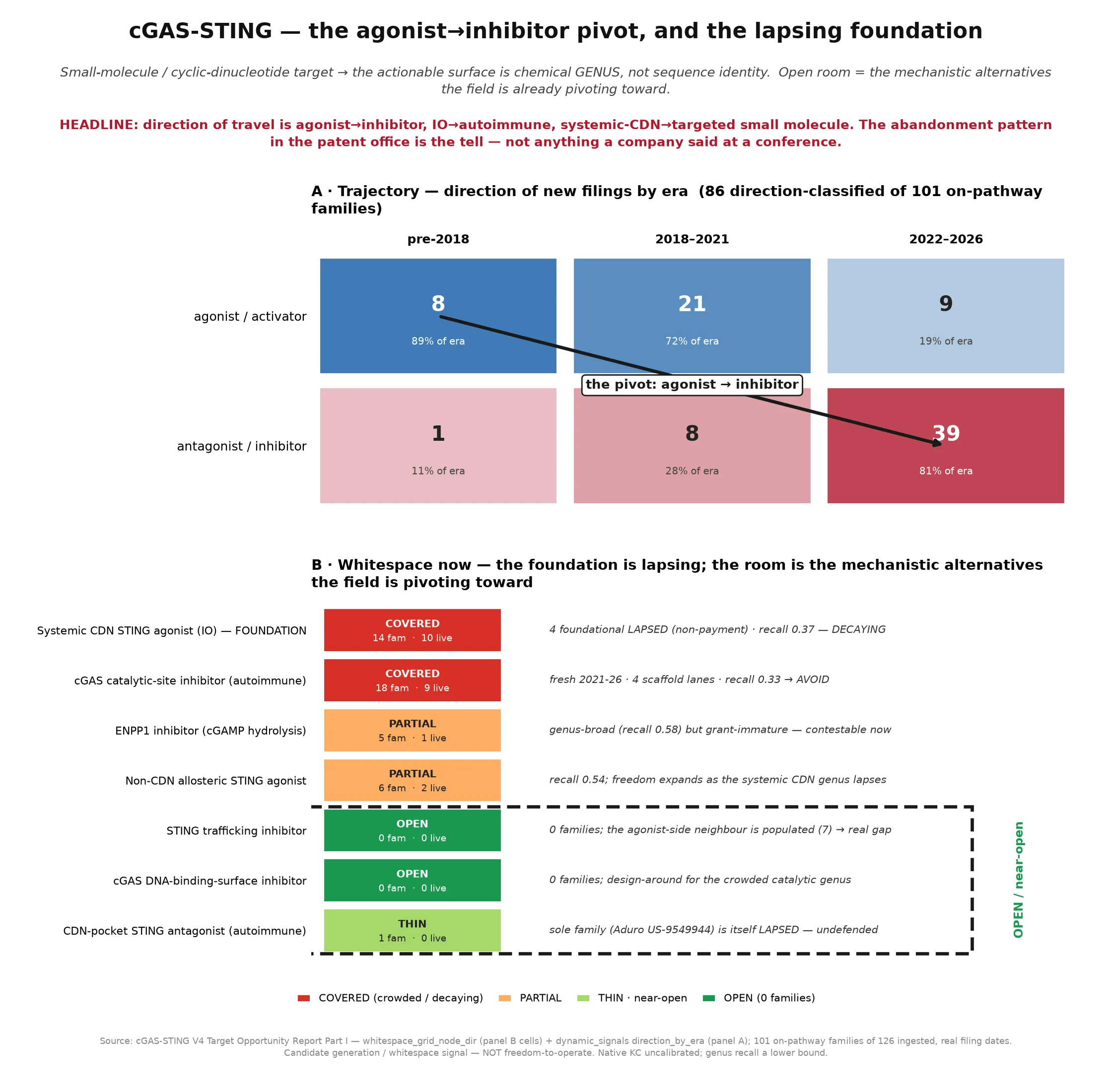
The first target class is cGAS-STING, the innate-immune DNA-sensing pathway: 101 on-pathway families out of 126 ingested, a graph of 304 nodes and 657 edges. The upper panel of Figure 1 is the trajectory across the 86 whose direction the graph could classify. Before 2018, the field was overwhelmingly agonist, with eight agonist families to a single inhibitor, because the first commercial thesis was to switch the pathway on for immuno-oncology. By 2022–2026 that trajectory has inverted hard: nine new agonist families against thirty-nine inhibitors, and the modality inverted with it. The systemic cyclic-dinucleotide (CDN) scaffold that carried the early agonist wave falls to zero new families in the current era, while heteroaromatic small molecules climb from nothing to dominate.
The lower panel shows where that leaves the room to build today. The foundational systemic-CDN agonist estate is not merely stale, it is lapsing: four broad early grants have gone abandoned for non-payment — one, a GSK composition patent, discontinued as recently as this July. The crowded center of gravity has moved to the cGAS catalytic-site inhibitor race aimed at autoimmune disease — eighteen families with nine still live, a lane to avoid. The room to build sits beside it. No family claims a STING trafficking inhibitor or a cGAS DNA-binding-surface inhibitor; the CDN-pocket antagonist cell’s single occupant is itself lapsed and undefended; and two further cells are contestable rather than clear — the ENPP1 inhibitor lane, genus-broad but grant-immature, and non-CDN allosteric agonism, where freedom expands as the CDN estate lapses. One reads this room from the abandonment pattern, not anything said at a conference.
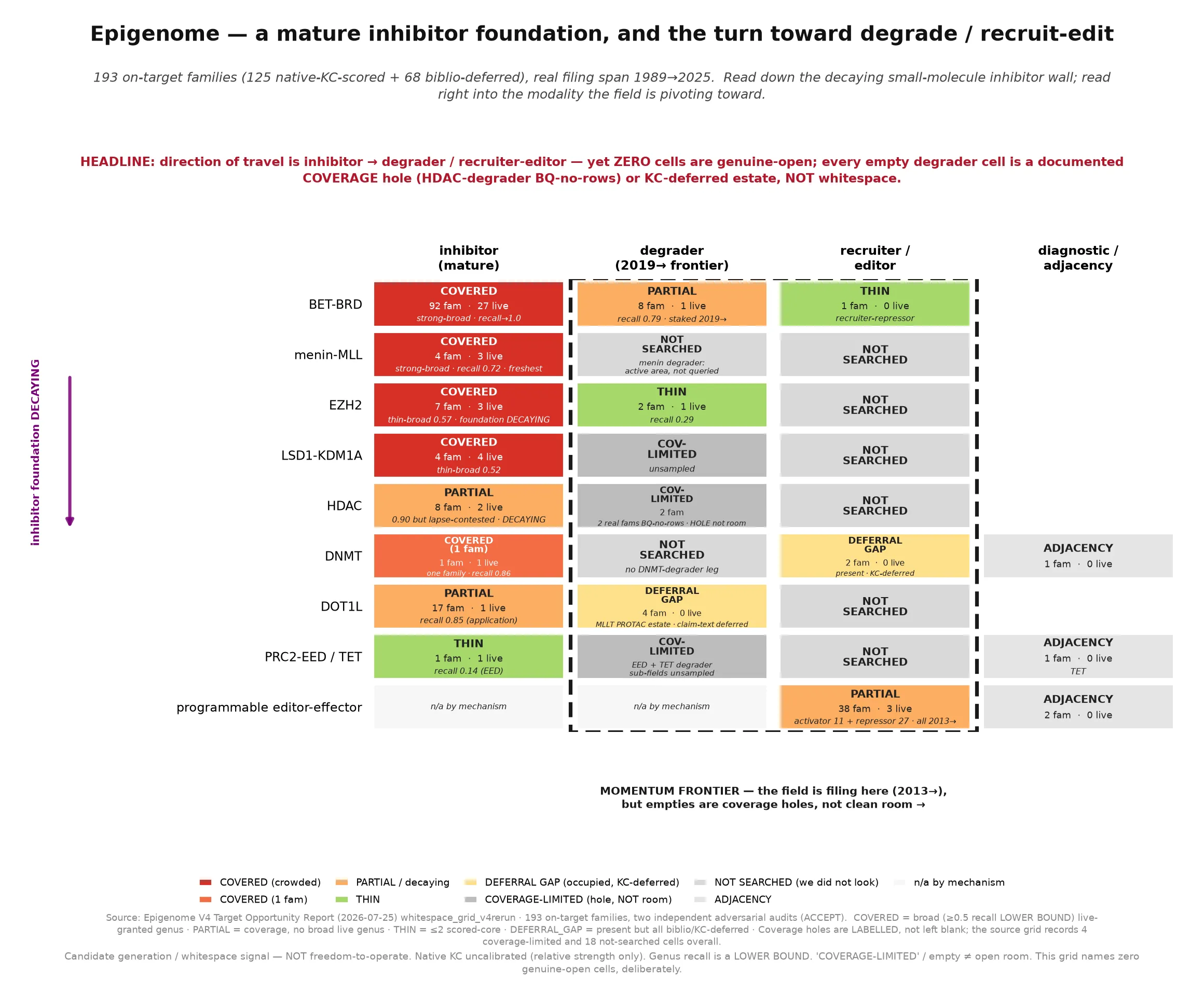
The second target class, the epigenome, tells a different story. Figure 2 is a single grid — enzyme node down the side, modality across the top, cells colored by how thoroughly structural claims cover them — over 193 on-target families spanning real filing dates from 1989 to 2025. Read down the left column and the mature small-molecule inhibitor foundation is decaying in places; the histone-deacetylase and EZH2 estates are older and thinning, while the freshest claims sit on the menin-MLL interaction and the broadest live-granted genus sits on a densely defended bromodomain (BET) estate. Read rightward and the momentum is datable: every degrader and recruiter-editor family was filed in 2013 or later, and the degrader modality is exclusively a 2019-onward phenomenon.
But the part of Figure 2 that matters most is what it refuses to color green: the grid names zero genuinely-open cells, deliberately. The empty histone-deacetylase-degrader cell is not whitespace — two real families in that lane could not be ingested at all — and the honest label for a cell you could not reach is coverage-limited, not open. Other empties are cells the sweep never queried, and the grey of those cells says so. Sometimes you can’t read the whole room in one pass, and a tool that can’t distinguish an empty cell it checked from one it could not read is worse than no tool at all.
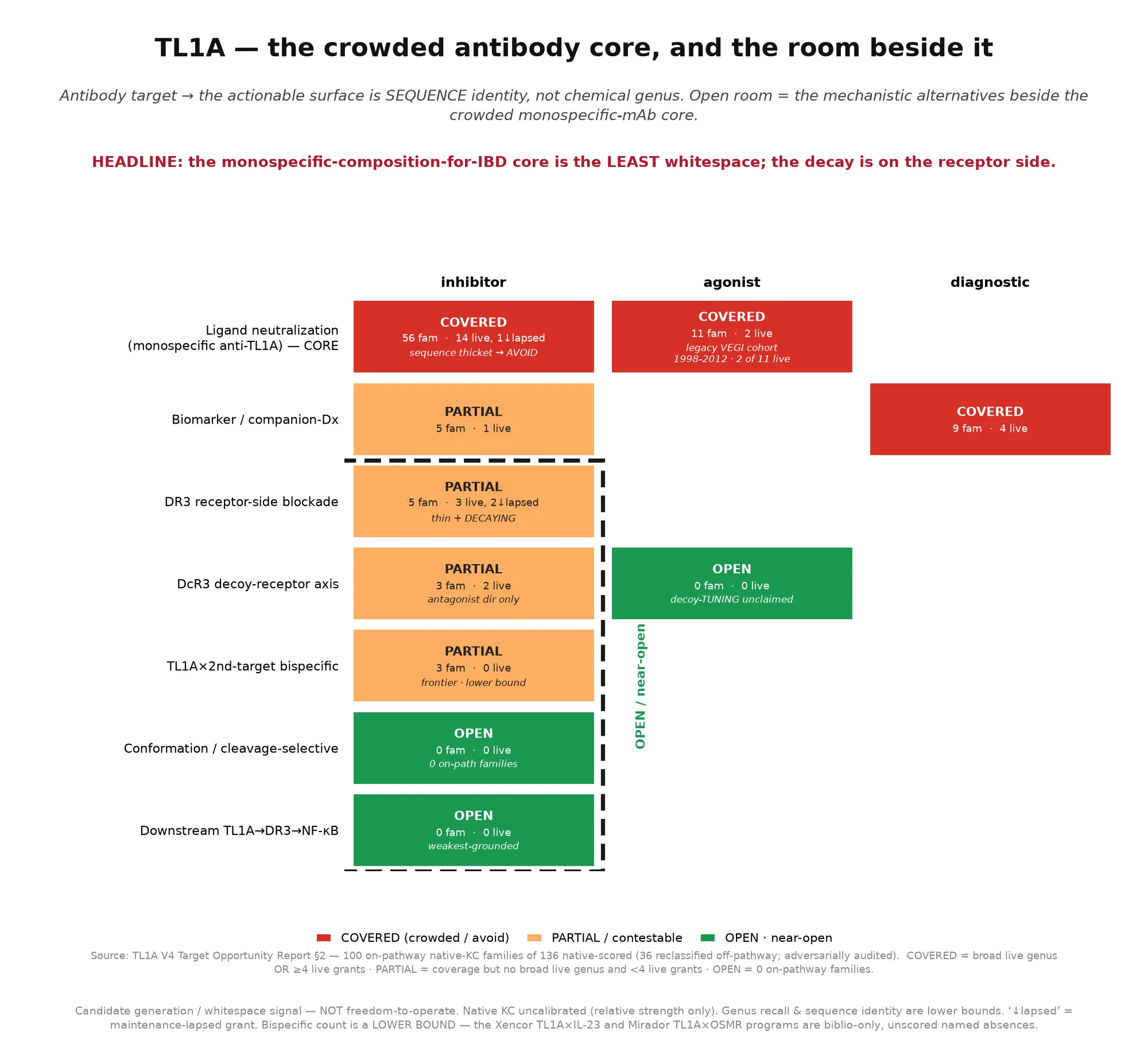
The third target class is TL1A, the target this series read backward in its fifth article, and the most instructive of the three. TL1A breaks a convenient assumption, because it is not a small-molecule enzyme target but a tumor-necrosis-factor-superfamily ligand-receptor axis whose therapeutic core is a neutralizing antibody. The actionable structural surface is therefore sequence identity, not chemical genus, and a chemical-whitespace grid drawn on it would be meaningless. Figure 3 is what the IP knowledge graph returns when it says so rather than manufacturing chemistry that isn’t there. Of the 136 families the TL1A target sweep pulled in, only 100 genuinely claim the TL1A–DR3 axis, so the raw hit count overstates the estate by about a quarter.
The crowded core is the monospecific anti-TL1A ligand-neutralization lane, fifty-six families — the sequence thicket where Cedars-Sinai, Pfizer, Bristol-Myers Squibb, Teva, and the Merck-acquired Prometheus estate all sit — and the companion-diagnostic lane beside it is covered too. The room to build is elsewhere: the thin, partly-lapsed blockade direction at death receptor 3 (DR3), the unclaimed tuning direction at decoy receptor 3 (DcR3), and a bispecific frontier that is a lower bound rather than a count, because named programs sit in the corpus as unscored bibliographic records.
TL1A has been antibody-led and inhibitor-dominant in every era, the opposite of cGAS-STING, consistent with its confirmed genetic association to inflammatory bowel disease. What changes late is where the filings are anchored: families first published in Chinese or international filings go from one to nineteen across the three eras.
To review, the rDNA IP knowledge graph read three target classes and returned three shapes, and the shapes are not interchangeable. A whitespace map is only as honest as the coordinate system it is drawn on, and in each case that system was built from the external biology and literature first, human-reviewed, and only then populated from the patent set — so the open cells are not artifacts of what happened to be filed. The numbers underneath them are lower bounds, and the strength scores grading the claims that do exist are calibration-pending, used for relative ordering only. Those are not disclaimers grudgingly attached at the end. They are the product. The supporting analysis for each of these three reads is posted at rDNA.ai, alongside the earlier article series.
In summary, the inventor’s forward-looking question absolutely pertains to a BD&L professional’s decision-making in a world where the comparable-deal record has thinned. Answering that question for a target class determines whether a program is worth starting and whether a partnership is worth entering. This question has always been answerable in principle by reading a target class’s whole patent record carefully. What was missing was a way to read it at the scale of the class rather than the asset, reproducibly, with every generated value traceable to the claim it came from. That is the IP knowledge graph we’ve built during the pause, and these three target classes are the first look at it in action. Using this tool, the biopharma BD&L professional may now “read the room,” any room and at scale, before competitors are even aware of their presence.