
Deals of This Decade: Who Owns ADC Platform Improvements?
An analysis of improvement clauses in 41 SEC-filed ADC platform alliances from 2020 onward, found through the Ex-10 search. Redacted terms remain undetermined, not absent; the codes describe filed allocations, not enforceability or recorded ownership, and do not constitute an FTO opinion. Unfiled agreements are outside scope.
In April 2025, for the last of my earlier series on alliance best practices, I climbed out on a limb about the decade we are in. Antibody-drug conjugates (ADCs), I wrote, “will take top honors as the most successful drug treatment modality of the current decade.” A prediction about a modality is also a prediction about the contract provisions that enable it, so I thought it useful to see how recent alliances have partitioned ADC improvements.
An ADC alliance is, among other things, a platform alliance. In each of the alliances reviewed for this article, the text filed with the U.S. Securities and Exchange Commission (SEC) names a platform originator, whose ADC technology or compound the alliance uses, and a partner that develops products with it. Every program the partner runs is an opportunity to improve the originator’s platform, which raises the question I took up in “Keeping an Alliance on Target”: who owns the improvement?
That article set out a hierarchy of protective measures, “ranging from least to most restrictive”: (1) segregating alliance technology and the people with access to it, then (2) contractual non-compete provisions, then (3) assigning improvements to the technology’s originator. It also sorted improvement clauses into five categories. In (i) Assign Improvements, every improvement goes to the originator. In (ii) Assign & License, the originator takes the improvements and licenses them back to the partner within the initial license scope. In (iii) License, improvements are not assigned and are licensed to the partner. In (iv) License-with-grant-back, they are licensed to the partner with a grant back to the originator. In the fifth improvement category, (v) ownership is joint, with each party owning its sole improvements.
For this update we read every ADC platform alliance dated 2020 or later whose agreement was SEC-filed and was found by our search of those filings. That gave 41 2020-26 ADC platform alliances coded against the five categories. Every code is computed from the clause text, quoted where the text speaks; where it is silent, the code records the silence.
In 25 of the 41 alliances, the words that decide where at least one part of the improvement clause falls, who owns the improvement or whether it is licensed back, are redacted. That is not the same as having no improvement clause; a redacted clause is still a clause. The two lighter protective measures in the hierarchy described above suffer less redaction-based attrition: a non-compete (measure 2) is visible in 25 of the 41 alliances, and segregation language (measure 1) in 17.
Where the improvements clause is visible, two of the five categories do almost all the work. Type (ii) Assign & License appears in 13 alliances, and type (iv) License-with-grant-back in 11; type (i) Assign Improvements and (iii) License each appear in one, and type (v) the joint category does not appear at all. For context, my earlier article reported Assign Improvements at 32% of instances and Assign & License at 20%.
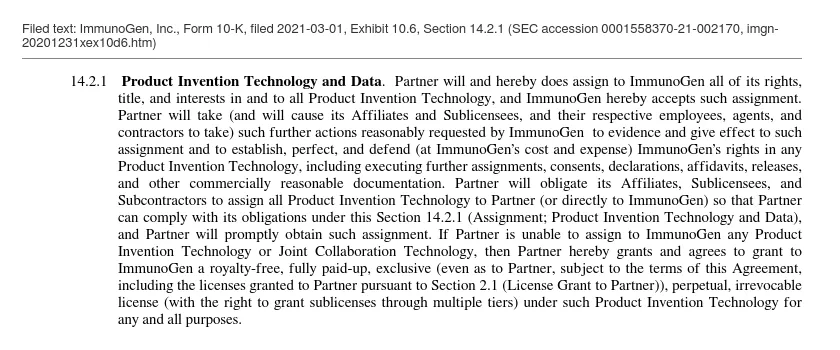
ImmunoGen’s 2020 collaboration and license with Hangzhou Zhongmei Huadong shows Assign & License in its plainest form. ImmunoGen solely owns the Product Invention Technology, and the partner “will and hereby does assign to ImmunoGen all of its rights, title, and interests in and to all Product Invention Technology.” The same technology then comes back to the partner, because the agreement counts it among the know-how licensed to the partner.
The five improvement categories also needed updating. In five recent ADC alliances, at least some improvements are owned by or assigned to the partner rather than the originator; in three, a class of improvements is jointly owned whoever invents it; and in one, the partner’s sole improvements become joint while the originator keeps its own. Splits are frequent: 20 of the 41 alliances divide improvements by subject matter or by a time trigger, so a single agreement can hold two categories or more.
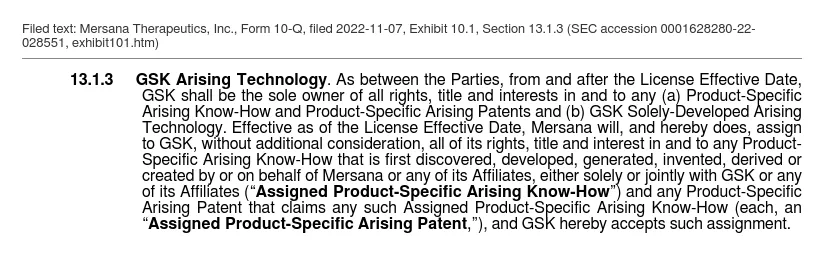
For example, GSK’s 2022 option and license with Mersana is a clear split. Mersana owns platform-specific improvements and GSK assigns its interest in them to Mersana, while “GSK shall be the sole owner” of product-specific improvements, which Mersana assigns to GSK.
For a business development and licensing (BD&L) professional benchmarking an ADC platform deal against recent SEC-filed comparables, the practical lesson is about reading rather than counting. Only 16 of the 41 alliances let you place every part of the improvement clause in a category from visible text. In the rest, the sentence that matters most is one you cannot read. What you can still read is where it sits: the heading that survives, the definitions around it, and any side letter filed afterwards. Archivists distinguish a missing file from a closed one. A missing file tells you nothing; a closed file tells you that a record was made, by whom, and where it sits on the shelf. In these recent SEC filings, the allocation of ADC platform improvements is more often a closed file than an open one, and the skill that pays is reading the shelf. A biopharma world without FOIA-released unredacted contracts is incomplete, but it is by no means bereft of insight.
The next article will review a very different and timely clause, the right to use a partner’s data to train or improve a platform, up against these same categories.