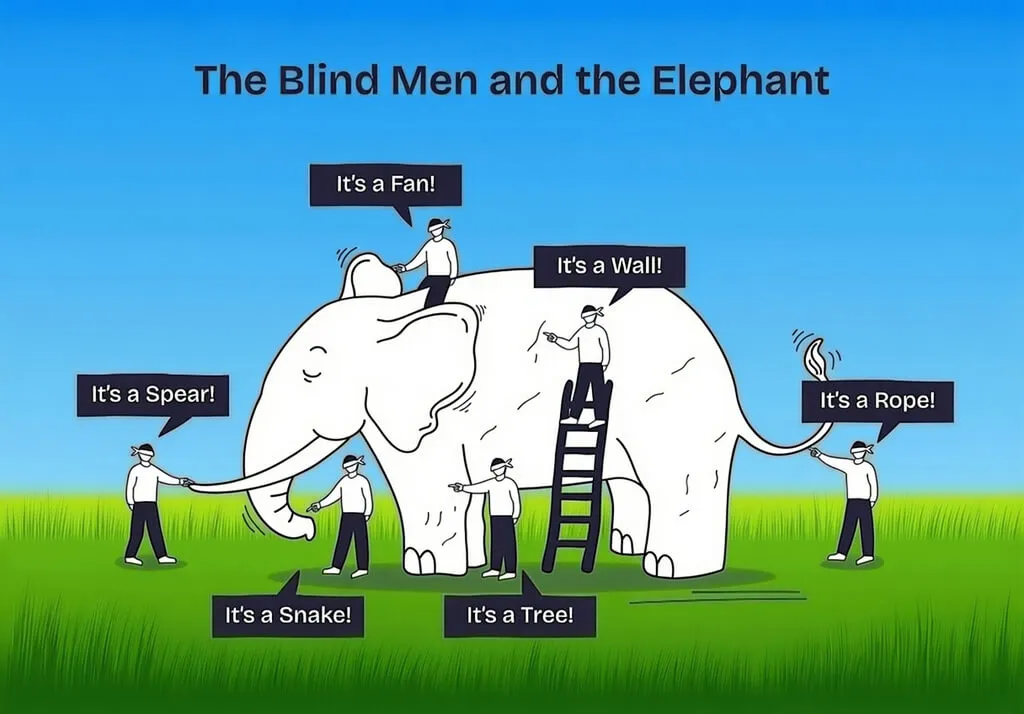
Six Blind Men and an Elephant
TYK2's structural-IP layer is the elephant that connects the deal flow, the clinical readouts, the cohort statistics, and the issued-claim records — and reading it requires the kind of methodological discipline the rDNA.ai series has been describing across the post-FOIA BD&L toolkit.
The Indian parable of the six blind men encountering an elephant is the analytical framing biopharma BD&L professionals need most often and use least well. Each man, touching only one part of the animal — the side, the tusk, the trunk, the leg, the ear, the tail — confidently declares what the elephant is: a wall, a spear, a snake, a tree, a fan, a rope. Each description is accurate to what the man touched. None is the elephant. The parable is widely taught as a lesson about the limits of single-vantage observation, but its actual analytical power is the inverse — it is a description of how multiple correct partial readings, assembled deliberately, become a complete reading. The professional who has read about a target class only through the deal flow has touched the tusk. The professional who has read it only through the issued claims has touched the leg. The professional who has read it only through the recent Phase 3 data has touched the ear. Each reading is correct; none is the elephant.
Tyrosine kinase 2 (TYK2) is the post-deucravacitinib competitive frontier in immune-mediated inflammatory disease, and the deal flow over the past fifteen months provides at least six independent vantage points on what kind of animal it has become. From the commercial-launch vantage point, TYK2 is Bristol-Myers Squibb’s Sotyktu franchise — first allosteric TYK2 inhibitor approved by the FDA in 2022, now reaching blockbuster status faster than projected, with no direct competitor yet at approval. From the Phase 3 vantage point, TYK2 is Takeda’s zasocitinib program — the next-generation asset from the 2023 Nimbus Therapeutics acquisition (approximately $4 billion), with Latitude PsO-3001 and 3002 data presented at the American Academy of Dermatology in April showing sPGA 0/1 in approximately 70% of treated patients at week 16 versus 30-32% for apremilast, on track for an FDA NDA submission in fiscal 2026, with a head-to-head study against deucravacitinib running in parallel. From the regional-outlicense vantage point, TYK2 is the field where Alumis outlicensed its Phase 3 oral TYK2 inhibitor ESK-001 to Kaken Pharmaceutical for dermatology in Japan in March 2025 ($40 million upfront, up to $140 million in milestones), demonstrating that the second-generation field has matured enough to support Phase-3-stage regional partnership economics. From the Chinese-originator cross-border vantage point, TYK2 is the field where Formation Bio licensed Lynk Pharmaceuticals’ Phase-1-ready CNS-penetrant TYK2 inhibitor LNK01006 for worldwide rights ex-Greater China in December 2025 ($605 million potential value, with Lynk retaining a minority equity stake in Formation Bio’s Bleecker Bio subsidiary). From the intra-Greater-China vantage point, TYK2 is the field where Fosun Pharma acquired Greater China rights to Accro Bioscience’s TYK2/JAK1 inhibitor AC-201 in August 2025 ($21.8 million, post-Phase-II for moderate-to-severe plaque psoriasis), demonstrating that the Chinese-originator competitive cohort is now mature enough to support intra-China rights-acquisition flow.
Each of those readings is accurate. None of them is the elephant. The elephant is the structural-IP layer that lies underneath each of them and connects them, and reading it requires the kind of methodological discipline the rDNA.ai series has been describing across the post-FOIA BD&L toolkit.
Before turning to that reading, one small structural-IP detail worth pausing on — because it is the kind of thing the deal-flow and clinical-data vantage points are constitutionally unable to surface. The foundational BMS deucravacitinib patent — US9505748B2, the composition-of-matter chain that became Sotyktu — does not contain the tokens “TYK2” or “Tyrosine Kinase 2” anywhere in its title or abstract. The patent uses indirect mechanism framing: Amide-substituted heterocyclic compounds useful as modulators of IL-12, IL-23 and/or IFNα responses. Read at the issued-claim level alone, the patent looks like a downstream-pathway modulator filing. Read at the full prosecution-wrapper level, it is the foundational deucravacitinib priority chain. The blind man who has touched only the issued-claim record cannot identify Sotyktu’s foundational IP from a “hot” target search; the patent simply is not labeled with the target.
The 204-patent post-2020 TYK2 cohort, scored against the six-component KC framework that anchored the GLP-1 backtest, contains 14.7% Chinese-originator filings at the cohort level — materially lower than CLDN18.2’s 39.1%. The blind man who has touched only that statistic concludes that the TYK2 field is structurally Western-dominated, with limited Chinese-originator competitive pressure. The tournament-calibrated top decile (n=21) reveals a different animal. Ennovabio Pharmaceuticals — a Shanghai-based originator — holds the cohort’s tournament rank #1 with US12617805B2 (ensemble 4.175), the cohort’s single most structurally rigorous filing on the V3 framework’s reading. Brigham and Women’s Hospital and the Broad Institute hold rank #2 (US20250255875A1, a bifunctional molecule). Then comes the Nimbus / Takeda foundational continuation: five Nimbus filings at calibrated ranks #3 through #7 (US11174264B2 at the head, with US20230391797A1, US20200231594A1, US20210238198A1, and US20220073528A1 behind it), interleaved with Takeda’s own continuation IP US20260078125A1 at rank #6. Kymera (TYK2 degraders) at rank #4. Arvinas (TYK2 PROTAC) at rank #5. Anrui Biomedical Technology — a second Chinese-originator — at rank #7 (US20240335443A1). Arvinas + Yale at rank #8. Alumis (ESK-001 originator US20250188093A1) at rank #9. LEO Pharma at #10 and #13. ImmuneEdge + Stanford at #11. Dauntless 1 at #12. 1910 Genetics at #13. Rezubio Pharmaceuticals — a third Chinese-originator — at #14 (US20250073338A1). Incyte at #15. Dana-Farber + Voronoi at #16.
The pattern this composition reveals is 180 degrees from where CLDN18.2 pointed. Where CLDN18.2’s foundational layer concentrated at Western originators (Allogene, Astellas, Regeneron) with Chinese-originator filings clustered in the middle of the cohort, TYK2’s foundational layer reads with Ennovabio at the top, three Chinese-originator filings in the top decile against a 14.7% cohort baseline (roughly proportional), and the Nimbus / Takeda continuation arc immediately behind Ennovabio as the cohort’s structural anchor. The China share is lower in absolute terms; the concentration at the foundation is higher. The blind man who has touched only the 14.7% statistic has the proportions right and the foundation wrong.
Two of the recent deal flow transactions ratify this reading. The Takeda zasocitinib Phase 3 data presented at AAD 2026 demonstrates that the foundational continuation arc the framework identified — the five Nimbus filings at ranks #3 through #7 — produced the now-clinically-validated next-generation TYK2 asset in the field, with sPGA 0/1 at approximately 70% of treated patients at week 16. The framework read the structural-IP layer eighteen months before the Phase 3 readout; the readout confirmed that the structural-IP layer the framework identified was the foundational continuation it appeared to be. The Formation Bio – Lynk Pharmaceuticals deal does parallel work on the Chinese-originator side of the cohort. Lynk’s TYK2 portfolio in the cohort comprises three filings under family ID 86774877 — US12129250B2, US20240124448A1, and US20250115597A1 (the third with 242 claims, one of the largest claim counts in the cohort). None of the three sits in the top decile by ensemble rank, but the family’s combined claim breadth and the structurally novel CNS-penetrant mechanism subclass it embodies were sufficient for Formation Bio to value LNK01006 at $605 million potential — an outlicense that effectively ratifies the structural-IP layer the framework was reading at the cohort’s upper-middle bands. The blind man who has touched only the Sotyktu commercial trajectory cannot see this; the blind man who has touched only the Chinese-originator-deal-flow vantage point cannot see this either. Together, with the structural-IP framework’s reading underneath, the deals trace the elephant’s outline.
What the CLDN18.2 and TYK2 readings together reveal — and what no single-target analysis or single-vantage observation could surface — is that Chinese-originator structural-IP positioning is target-class-specific rather than categorical. In post-2024-approval CLDN18.2, the Chinese-originator cohort share is high and concentrates progressively further from the foundational layer with each tightening of the analytical lens. In post-2022-approval TYK2 with active second-generation competition, the Chinese-originator cohort share is lower but concentrates at the foundational top, with Ennovabio holding the cohort’s highest-ranked filing and Lynk’s portfolio supporting a $605 million outlicense to a Western pharma. The deal flow over the past fifteen months — Alumis-Kaken, Fosun-Accro, Lynk-Formation Bio, and the Takeda zasocitinib Phase 3 readout — runs across all three patterns, and the BD&L professional valuing the next TYK2-related transaction needs the target-class-specific structural read rather than a categorical assumption about where Chinese-originator IP sits in the field.
The six-component KC scoring framework, the tournament-calibrated top-decile rankings for TYK2 (204 patents), the per-patent sub-dimension breakdowns, the methodology calibration for small-molecule chemistry, and the documentation are written up in full at rDNA.ai, along with the underlying scoring results.
The parable’s analytical lesson is not that each blind man is wrong. It is that each blind man is right about the part he has touched, and that the elephant emerges only when the partial readings are deliberately assembled into one. The structural-IP layer is the elephant. The deal flow, the clinical readouts, the cohort statistics, and the issued-claim records are the parts. The BD&L professional who reads only the parts can describe each accurately and still mistake the animal — and the diligence work on each new target class is exactly the assembly the parable points at.
This is the eighth article in the rDNA.ai biopharma BD&L series.
Here’s the start of the series.