Queen’s Gambit Accepted: The IL-6 Ligand Hurdle
The eighteenth article in the rDNA.ai biopharma BD&L series reads the IL-6 target class through therapeutic patent families, regulatory clocks and ownership lineages, showing how the field’s structural boundaries persist after a clinical setback.
On the morning of July 31, Novo Nordisk announced topline results from ZEUS, the cardiovascular outcomes trial of ziltivekimab, its antibody against the interleukin-6 ligand. From a biology perspective, the drug did what it was designed to do: free IL-6 fell, C-reactive protein fell; so, the pathway was engaged. But the engagement did not translate to a therapeutic benefit — no reduction in major adverse cardiovascular events against placebo in more than 6,300 patients with atherosclerotic disease, kidney disease and inflammation, a hazard ratio of 0.99 with a confidence interval running from 0.88 to 1.11. A point estimate sitting at unity, with the full data still to come.
Earlier this month the geneticists Liang Chang and Mary Helen Black published the most useful framing of that result I have read. Drug targets with human genetic support reach approval at roughly twice the base rate — a finding replicated for a decade. But there are two hurdles between a genetic signal and a medicine, they argue. The first turns a locus into a causal gene and a direction; the second turns a validated target into a treatment hypothesis — this molecule, at this exposure, for this duration, in these patients. IL-6 cleared the first hurdle years ago, about as convincingly as a cytokine can. ZEUS tested the second, which is its own experiment. That second hurdle — the one in this article’s title — is a hurdle of trial design and exposure, not of node choice: nothing here argues that the ligand was the wrong place to stand. Genetics de-risks the target. It does not de-risk the trial.
From a BD&L professional’s perspective, the corollary is the most interesting part. The first conversion is public. The genetics that made IL-6 a credible cardiovascular target was published widely, and the conviction it created is visible not in any one R&D pipeline but in the patent record of the whole field. Interleukin-6 may be the most thoroughly drugged cytokine in medicine: four marketed biologics — tocilizumab, sarilumab and satralizumab at the receptor, siltuximab at the ligand — and, those four included, thirteen named current clinical assets in all, seven directed at the ligand, five at the receptor, one at the gp130 signal transducer. The most crowded cell on the entire patent map of this target is full-length antibodies against the ligand: 139 families, exactly the square where ziltivekimab sits. Novo paid to stand there — the Corvidia acquisition of June 2020, $725 million up front and up to $2.1 billion in total, principally for this molecule. Shared conviction is expensive precisely because it is shared.
Those counts come from a collection of 6,338 IP publications in 1,682 families, screened to 778 with positive evidence of therapeutic intent — a hard screen, because IL-6 is among the most commonly measured analytes in medicine and an immunoassay antibody looks exactly like a therapeutic one until you read the claims — and the screen is claim-backed for 571 of the 778 therapeutic families; the other 207 carry no claim text at all and were screened on title and abstract alone. Every count here is a floor: 195 families could not be resolved to a modality and 569 have no resolvable assignee, so every owner roster is a minimum, not a census.
Now put the dates side by side. Until July 30 of this year, the clinical thesis on this target supported an acquisition worth up to $2.1 billion and a multi-trial cardiovascular outcomes program. On July 31 Novo Nordisk said it expected a non-cash impairment charge in the third quarter. Five weeks later the repricing ran again: in early September, Novo’s heart-failure trial HERMES was terminated, a discontinuation that press reports attribute to a data monitoring committee’s read of the totality of the data, leaving ARTEMIS, in the acute setting after a heart attack, to read out in the first half of 2027. Novo’s IL-6 patent layer did not move either time. The 139 IP families in the ligand-antibody cell on July 30 were 139 families on August 1, and they are 139 families today. The fences, the timelines and the owners are exactly where they were. The finding of this analysis is a fence line, not a gap, and fence lines do not reprice on topline clinical outcomes.
The figure below is the fence line structure on one page: the occupancy grid on top — seven mechanism nodes by sixteen modality lanes, three of them carrying no families at all and so not drawn, which is why the figure shows six by fourteen — with the two most-built cells of resolved modality outlined at 139 and 102 families, and and the thirteen clinical assets below, each node carrying its regulatory floors, its filing history by era, and the ZEUS readout marked on the ligand row.
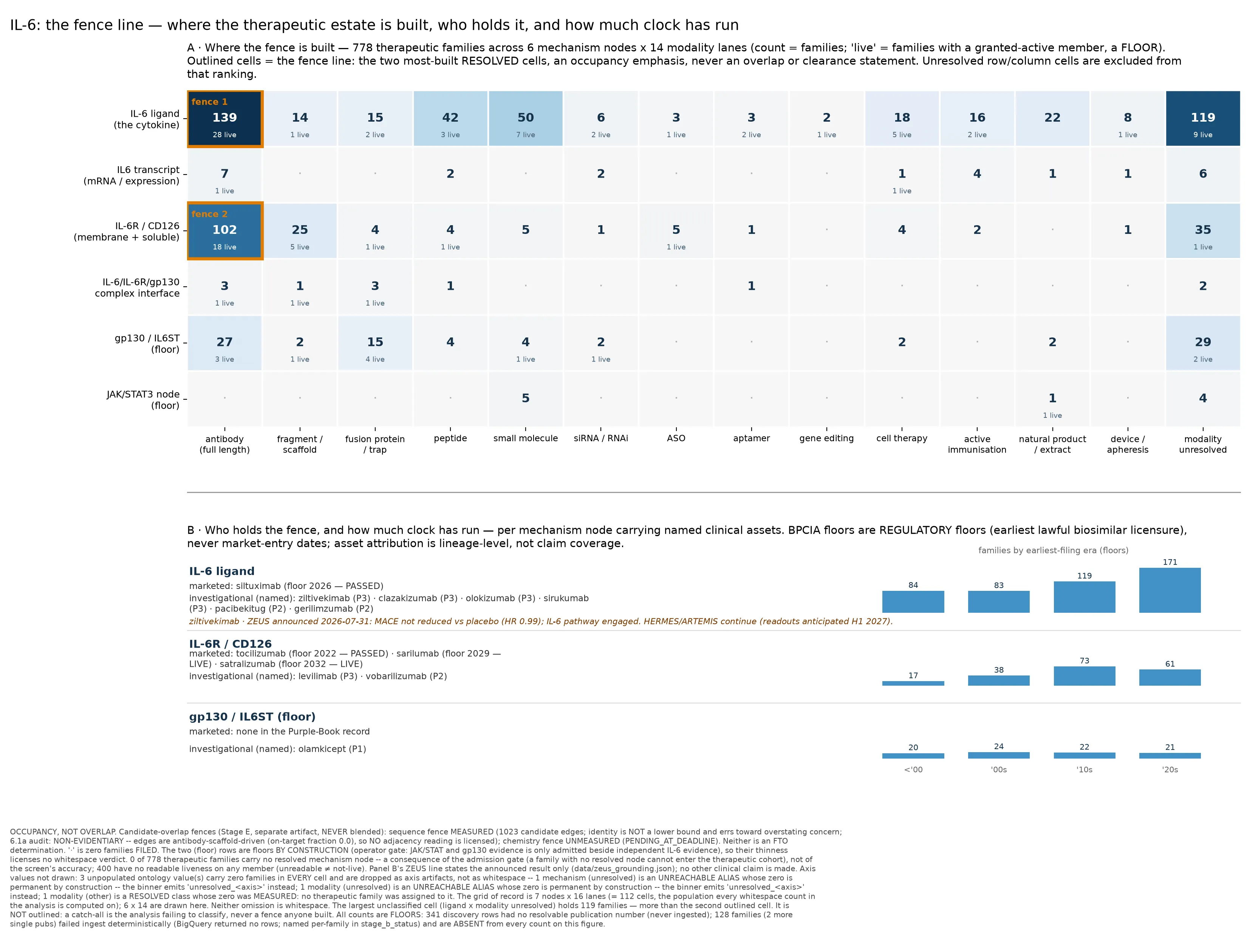
The timelines matter because both fences have incumbents. Under the Biologics Price Competition and Innovation Act (BPCIA), a reference biologic carries twelve years of exclusivity from first licensure — a floor marking the earliest date a biosimilar may be licensed, not a prediction of when one arrives, since the reference product’s patent estate routinely holds the gate long after the statute opens it. Two of the four BPCIA floors on this target have already passed, one on each node: tocilizumab’s at the receptor in 2022, siltuximab’s at the ligand this April. Sarilumab’s runs to 2029 and satralizumab’s to 2032. And each new entrant carries its own timeline: a first approval starts a fresh twelve-year clock, in whatever indication earns it.
The modality trajectory is the finding I did not expect. The ligand node is the oldest territory on this map — its earliest therapeutic family dates to 1987 — and it is also the fastest-growing: 84 families before the millennium, 83 in the following decade, 119 in the next, and 171 since 2020, the most active node-era anywhere on the map. The receptor node rose the same way and then turned, 73 families in the prior decade against 61 in the current one. New filing favors the challenger’s node over the incumbents’, and it began doing so years before any cardiovascular readout existed. Whatever the new IL-6 filers were pricing, it was not ZEUS.
Ownership is the third structural fact, and the one I would want in front of me during diligence. These estates outlive their owners. Eleven of the thirteen clinical assets have patent lineages naming more than one party; ziltivekimab’s own composition lineage runs from MedImmune through Corvidia to Novo Nordisk, and for two assets on this map the split is total — every IP family at the asset’s node sits with an originator, and the trial sponsor holds none. On a target nearly forty years old, the name on the trial and the name on the fence are different names often enough that checking one tells you little about the other.
Finally, I owe the reader an accounting of what this analysis could not do. The whitespace layer found sixty empty cells, of which only sixteen are readable as whitespace at all; I report none of the sixteen as opportunity — several are combinations a molecule cannot inhabit, and no biological-coherence screen was run. The sequence-overlap layer ran to completion and then failed its own audit: of the 237 publications its alignments reached, not one names this target in its title — the edges trace shared antibody scaffolds, so the layer measured antibody-ness, not interleukin-6-ness. The chemical-genus comparison never returned at all. No overlap statement about any estate named here is resolved by this work, and none of it is freedom-to-operate analysis. As for why ZEUS missed, nobody knows yet: the full data are unpresented, and the most discussed mechanistic account — that a protective receptor variant is not the same perturbation as a ligand antibody — is contested by the very geneticists who built the IL-6 case. I take no position an outcomes trial has not taken first.
Chess players know that the most heavily analyzed openings never empty out — they fill up, because the players who know the first twenty moves best keep finding move twenty-one. When a famous game with a classic opening is lost, the opening isn’t abandoned; what changes is the annotation about what happens next. That is what July 31 did. One well-reasoned approach lost one game, in one population, and every IP fence, timeline and owner on this map stands where it stood the night before. A crowded field is not a deterrent, and one result does not disperse it. The biology stands firmly behind IL-6, but the second hurdle remains.