Pivoting Upstream Means Fighting Both Current and Time
The fourteenth article in the rDNA.ai biopharma BD&L series reads the MAPT / anti-Tau target class through forward-looking whitespace and trajectory analysis, showing a field that moved upstream to an already crowded transcript layer.
On May 14 of this year Biogen released Phase 2 topline results for diranersen, an intrathecal antisense oligonucleotide directed at MAPT messenger RNA for treatment of Alzheimer’s, and presented the full dataset at the Alzheimer’s Association International Conference in London on July 14. The trial, called CELIA, missed its primary endpoint and the largest effect came from the lowest dose, with most supporting differences reaching nominal significance only. Cerebrospinal-fluid total tau fell 50 to 65 percent across all doses, so the drug did engage its target. Biogen is advancing to Phase 3. The molecule was discovered by Ionis, and Biogen exercised a worldwide exclusive license in December 2019.
The most interesting thing about tau at this stage isn’t the Phase II readout. It is that the field has completely changed its mind about this target, and that pivot is legible in the patent record with dates attached.
Targets turn over in at least two very different ways, and the twelfth article in this series showed the first. PCSK9 turned over by modality. The mechanism was validated once and never moved, while five distinct formats — monoclonal antibodies, small interfering RNA, antisense oligonucleotides, vaccines, and now oral chemistry — competed to deliver it, and the newer formats displaced the older ones rather than stacking on them: full-length antibody families fell roughly 90 percent from their 2013–2018 peak, and in the current era orals outnumber antibodies four to one in new families. Tau turned over the other way. Here it was the mechanism itself that moved. The extracellular-antibody thesis that absorbed most of the 2010s largely failed in the clinic, and so the investment in tau moved upstream to the MAPT transcript.
To see this turnover in practice, we ran tau/MAPT through the whitespace and trajectory layer first described in the tenth article, and read the replacement pivot via patent claims rather than press releases.
783 patent families were ingested. 267 carried claims readable enough to place on a coordinate system, and 223 of those were genuinely on this pathway. The 44 that dropped out did so based on the claim content rather than the patent title. Real filing dates run from January 1995 to September 2025. Fourteen of the 48 discovery slices came back saturated at their result ceiling, so the true size of the underlying record is unmeasured, every count here is a lower bound, and nothing below is a comparative claim about how large this landscape is against any other.
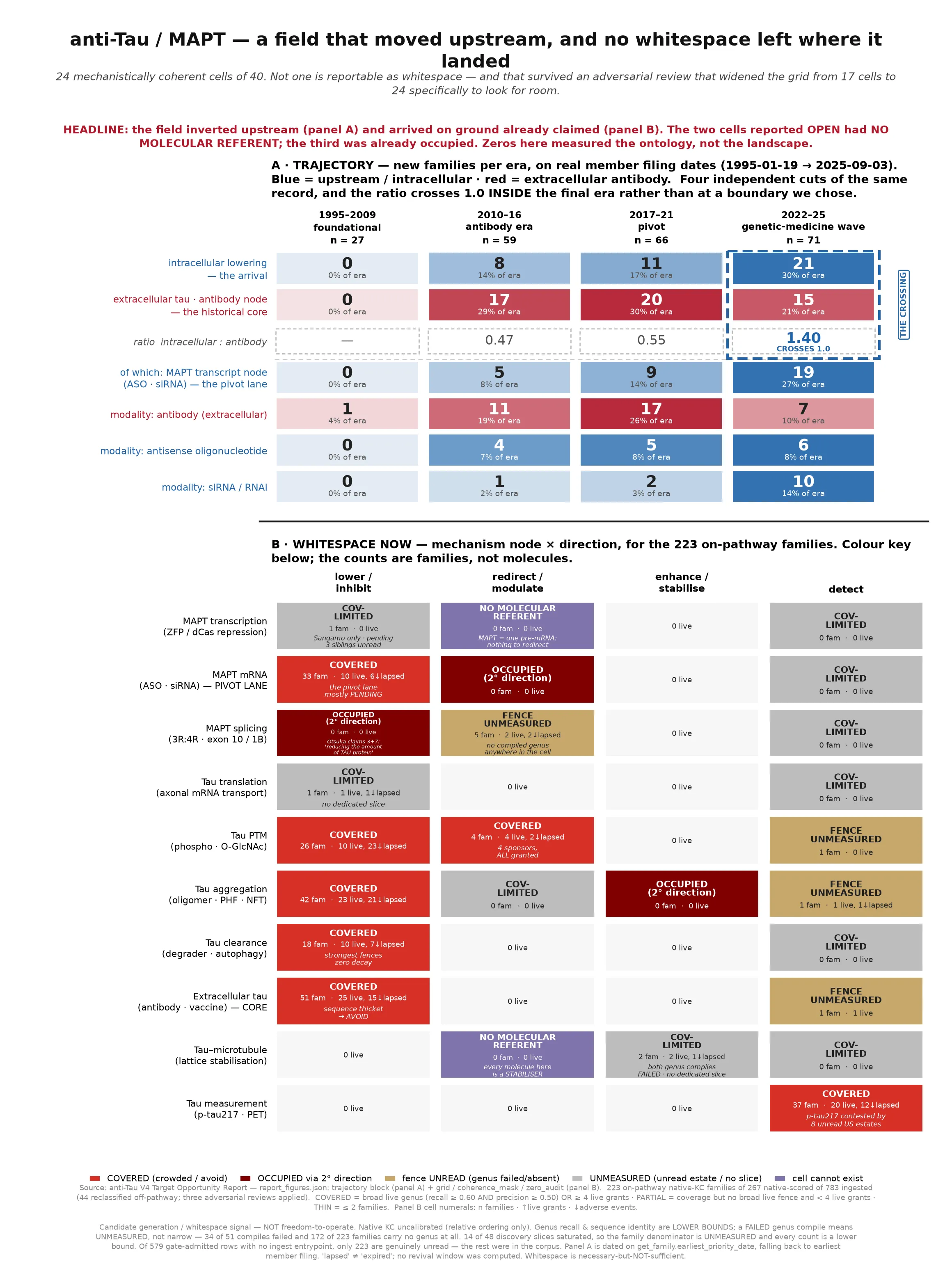
The upper panel is the trajectory, cut on real filing dates and split by mechanism rather than by sponsor. New families per era run 27, 59, 66, 71 across the foundational period to 2009, the antibody era to 2016, the pivot years to 2021, and the genetic-medicine wave to 2025, respectively. Inside those totals, families claiming intracellular lowering run 0, 8, 11, 21. Families on the extracellular-antibody node run 0, 17, 20, 15. The ratio between them moves from 0.47 to 0.55 to 1.40, and the crossing happens inside the final era rather than at a boundary we chose. Cut by node instead, the MAPT transcript alone runs 0, 5, 9, 19. Cut by modality, extracellular antibodies run 1, 11, 17, 7 while small interfering RNA runs 0, 1, 2, 10 and antisense runs 0, 4, 5, 6. Four different cuts of the same record agree on direction, which is the reason to call it an inversion rather than a wobble.
The lower panel is where the pivot stops being a story of open whitespace. The cell diranersen occupies — the MAPT transcript, lowering direction — is one of seven cells that came back covered, with 33 families sitting on it. The other six are covered too: extracellular tau at 51 families, aggregation at 42, post-translational modification at 26 and again at four in a second direction, measurement at 37, clearance at 18. The field rowed upstream and found the moorings taken. Six of the 33 transcript families belong to Ionis and Biogen, which is to say the sponsor now entering Phase 3 holds under a fifth of the cell its own asset sits in. The remaining 27 are spread across Alnylam, Novartis, Roche, Eisai, Lilly, Denali, Voyager, Arrowhead, Dicerna, Genzyme, AdaRx, Atalanta, BioOrchestra, four recent entrants whose nationality we decline to infer from an assignee string, and six universities. Nobody owns the upstream foundation, and everybody is standing on it.
Then the harder result. We built the coordinate system before placing anything on it, and then deliberately widened the mask of cells we were willing to treat as mechanistically coherent, which took the coherent set from 17 cells to 24 out of 40. Widening a mask permissively is the move most likely to manufacture whitespace. Raw verdicts came back as seven covered, one partial, three occupied through an adjacent direction, six thin, and seven reading as open. We then cross-examined 18 cells that read as empty or near-empty. None survived as reportable whitespace.
Of the 18, eleven are unmeasured: no discovery slice ever targeted that claim type, or ingested families matching the cell exist whose claims we could not read, or direction-appropriate estates exist that we could not reach at all. Three are a convention artefact of how detection claims bind to a mechanistic node, and contested besides. Three are occupied in an adjacent direction on the same node. One is measured, occupied, and simply lacks a broad live fence. The bottom line is not that tau has no whitespace. It is that there is no cell on this target where we can presently demonstrate whitespace.
The tau-fusion landscape was surprising. Four families in this record, all filed by RNA Therapeutics, Inc. between August 10 and September 16 of 2024 — 37 days end to end, with gaps of 16, 5 and 16 days between filings — claim single-chain antibody–transferrin fusions of gosuranemab, semorinemab, tilavonemab and zagotenemab. Those are four shelved anti-tau antibodies from four different originators — the originator attributions and clinical histories here are external facts rather than findings from the patent record — re-engineered for brain delivery by a third party and filed as a portfolio in five weeks. All four fusion families are pending. None is granted. A pivot that leaves failed assets behind creates its own asset class, and only a claim-level read surfaces it.
Two more things the record says plainly. On liveness, 109 of the 223 families are live and granted somewhere and 86 are still pending, but 91 carry at least one adverse event — abandonment, maintenance-fee lapse, regional non-entry, rejection — and 45 of those 91 remain live through a sibling. Reading adverse events at the member level rather than the family level would have written off 45 estates that are still enforceable. Six families are lapsed, which is not expired; we computed no revival window and make no claim about one.
On structure, 172 of the 223 families produced no compiled genus at all, and of the 47 recall figures we do have, 30 came from compiles that failed their own quality gate. A failed compile means unmeasured, not narrow — the single easiest way to turn a landscape analysis into a confident fiction is to read those as small fences. Nine families are live and clear both a recall floor and a precision floor, and those nine are the ones worth an attorney’s afternoon.
Tau’s record shows a field that read its own clinical failure correctly, moved in the right direction, and moved late — and it shows that with dates, which is the part no clinical readout provides. The patent graph cannot tell anyone whether lowering the MAPT transcript will help a patient; it reads claims, not brains, and the CELIA clinical readout is designed for the latter. What it can do is date the turn, count who was already standing at the new destination, and name the eleven cells where our own measurement, rather than the market, is the thing that came back empty. The supporting analysis for this read is posted at rDNA.ai, alongside the earlier articles in this series.
A replacement pivot is the most expensive kind of target turnover in the drug development business, because the key question stops being whether the new mechanism is right and becomes whether anyone can still get a defensible IP position on it. Navigating upstream has a property that open water does not: the channel narrows as you go, and the moorings are taken in the order they were reached. The tau field turned in time. It did not turn early.