
Pitching for the Record: Unredacted Royalty Terms in Recent Biopharma Agreements
An analysis of unredacted royalty terms in 279 SEC-filed contracts signed in 2018 or later, found through the Ex-10 search. Redacted rates and thresholds remain hidden; codes describe filed text, not enforceability or value, and do not constitute legal advice or an FTO opinion. Unfiled agreements are outside scope.
My last article, One Law, Multiple Yardsticks, described how recent biopharma contracts filed with the U.S. Securities and Exchange Commission (SEC) cut royalties when Medicare negotiates a drug’s price. This article analyzes the royalty rates themselves. In my earlier LinkedIn series article II.C Territory Splits, titled Global Vs. Regional Alliances, I compared deals by their Effective Royalty Rates (EFRs), the royalty payable at an assumed level of annual sales divided by those sales, and reported that at Phase I/II or Phase III stages at signing “regional alliances show a significant premium in EFR [versus global deals] to the project’s originator.” Those figures came from SEC-filed deals commenced 2013–21 (in practice none later than 2018), derived from unredacted contracts obtained via the Freedom of Information Act (FOIA).
Three changes at the SEC in 2020 stopped that deal flow, so for recent agreements the royalty rates we can read are the ones filers leave unredacted. To see what they show, we reviewed all the agreements found by our search of SEC filings whose text sets a royalty on net sales with at least one rate visible and whose contract signing date is 2018 or later: 279 contracts. We set aside 23 whose licensed product is not biopharma and 6 that duplicate another record’s alliance, leaving 250. Following the article II.C convention of exclusive licenses from corporate licensors, this EFR comparison keeps those contracts whose royalty terms set a kind of schedule an EFR can be computed from and whose development stage at signing we can date: 116 contracts, 83 of which have every rate and threshold an EFR at $500 million needs left unredacted.
Medians are the better guide than averages for small cohorts grouped by stage at signing. At $500 million in annual sales, the median EFR is 5% for discovery and lead-stage deals (25 contracts), 5.5% at preclinical (14) and 7.25% at Phase I/II worldwide (16), against 4% (32 deals), 6.5% (36) and 8.1% (31) for similarly staged cohorts in the article II.C analysis. At Phase III worldwide the median is 15% against article II.C’s 13.6% (6), though on only 5 contracts, and for approved or registration-stage products, a row that article II.C did not have, it is 11.5% across 12 contracts. So in the SEC-filed record of recent and unredacted royalty provisions, the medians at those four stages sit within two points of article II.C’s.
Small cohort averages are pulled strongly by single contracts. NanoViricides’ 2023 license to Karveer Meditech for India carries a 70% royalty, which lifts the preclinical average EFR at $500 million from 6.8% across 13 contracts to 11.3% across 14. The regional rows are too thin to test article II.C’s regional premium: only 2 Phase I/II regional contracts carry an EFR, and the 7 at Phase III have a median of 12%, against 15% for the 5 worldwide ones and 16.6% for article II.C’s 21 regional deals. That Phase III regional row also holds a 50% base rate, in CytoDyn’s 2019 license to Vyera, which is why its average EFR of 18.0% says little.
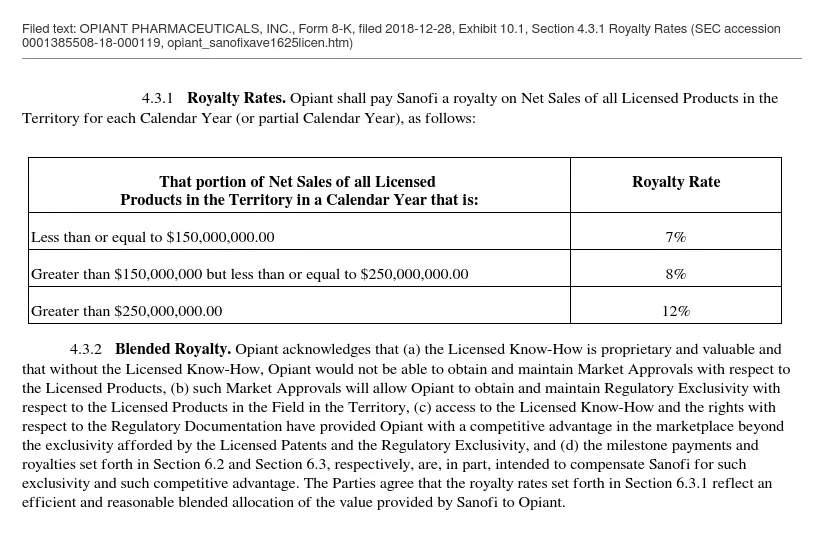
Sanofi’s 2018 license to Opiant shows the EFR arithmetic on a fully disclosed schedule: 7% of annual net sales up to $150 million, 8% up to $250 million and 12% above. At $500 million that is an EFR of 9.7%, well below the 12% top rate.
Across all 250 recent biopharma alliances with unredacted royalty terms, a single flat rate is the most common schedule, in 115 (46%), with a median rate of 5% across the 114 that print it; tiers by annual sales appear in 56 agreements (22%), rates that change on an event such as loss of patent coverage in 43 (17%), and both in 7. The sales thresholds are often hidden: 29 of the 56 tiered schedules redact them. In 31 of the 43 stepped schedules, the step comes when patent or valid-claim coverage ends.
Merck KGaA’s 2022 license to PDS Biotechnology, signed while the product was in Phase I/II, is a flat-rate example: PDS pays “a royalty of ten percent (10%) on aggregate Net Sales of Product in the Territory”, above the Phase I/II worldwide median of 7.25%. The clause adds that “Except as expressly set forth in this Agreement, such royalty shall not be subject to offset or reduction for any reason.” Section 5.4b then cuts it on U.S. sales where no valid claim covers the product, in a country where a biosimilar enters, and by part of what PDS pays for third-party licenses, with a cap on the total cut; all of those percentages are redacted.

What percentage of recent SEC-filed agreements have unredacted royalty provisions? We drew a random sample of 300 of the 1,553 documents filed in 2020 or later in which our search found a royalty clause with no rate visible, checked each, and grouped them into particular alliances. That gives about 920 alliances with every royalty rate redacted, against 336 with an unredacted rate, so about 27% of the royalty-bearing biopharma alliances SEC-filed since 2020 that our search found show an unredacted rate (95% confidence interval is 25% to 28%). That interval covers sampling error only; the other error sources pull in opposite or unknown directions and are set out in the full report.
Our selection of unredacted royalty provisions is the main caveat on everything above. The results above describe the alliances whose filers left a royalty rate unredacted, not those filed with every rate redacted or never SEC-filed at all, while the earlier section II.C analysis described FOIA-released copies of deals mostly commenced in 2017 or earlier. The two windows overlap only in 2018, which holds 8 of our 116 contracts, so this comparison sets a reading beside a benchmark; it does not measure a change.
For a business development and licensing (BD&L) professional pricing a license, the practical lesson is to benchmark on the median EFR at the deal’s stage, to read the tier thresholds before the top rate, and to treat any cohort of a handful of contracts as an anecdote. A baseball scout with a radar gun knows his readings are real, but only for the pitchers who agreed to throw in front of him. In the SEC-filed record we can read, every rate is a real term from a real contract; what that record cannot show is what the redacted majority agreed.