
The Oldest New Clause: Training a Platform on a Partner’s Data
An analysis of data-training terms in 38 SEC-filed platform alliances dated 2020 or later and a check of 193 earlier folders found through the Ex-10 search. Redacted clauses remain undetermined, not absent; codes describe filed allocations, not enforceability or recorded ownership, and do not constitute an FTO opinion. Unfiled agreements are outside scope.
My last article ended with a promise: “The next article will review a very different and timely clause, the right to use a partner’s data to train or improve a platform, up against these same categories.” A platform that learns from the data it is given makes that right valuable, and my working title for this article called it the newest clause in the contract.
Before reading any earlier contract, I committed to a test of that title: read the alliances dated before 2020 whose agreements were filed with the U.S. Securities and Exchange Commission (SEC), under the same tests used for the recent ones, and see whether the training term was already there. It was. Of the 193 harvested folders dated before 2020, 123 were read, and between 28 and 32 alliances, depending on how two readers’ disagreements are resolved, already carried an explicit training term, either a permission or a restriction. The earliest on which both readers agree is Genaissance’s 2000 agreement with Janssen.
Under that agreement, if Janssen found an error in Genaissance’s database of genetic variation, Genaissance “may thereafter include such information in the ISOGENOMICS(TM) Database for use by Janssen, Genaissance, and any other licensee” of that database. The vocabulary was a database rather than a model, but the question of who may use a partner’s data to improve the platform is the same.
To identify recent data-training alliances, we read every drug-discovery alliance dated 2020 or later whose agreement was SEC-filed, was found by our search of those filings, and uses an artificial-intelligence or computational platform. Of 152 candidates, 38 alliances were coded against the five improvement categories used in my ADC improvements article. Every code is computed from the clause text, quoted where the text speaks; where it is silent, the code records the silence, and nothing hidden is inferred.
In these filings, the training term is common but far from universal. Of the 38 alliances, 24 state a right to use partner data to train or improve the platform, or a restriction that reaches that data; in 8 the words that decide it are redacted; and 6 say nothing about it. Silence on training is not silence on improvements: 4 of those 6 still allocate platform improvements, so a training right cannot be inferred from an improvement clause.
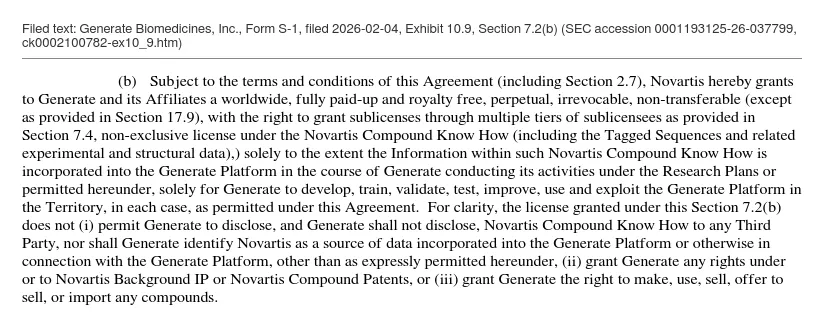
Novartis’s 2024 collaboration and license with Generate Biomedicines shows the explicit form. Novartis licenses its compound know-how to Generate “solely for Generate to develop, train, validate, test, improve, use and exploit the Generate Platform,” and Novartis “will, and hereby do, assign to Generate” its interest in inventions that improve that platform.
Against the five categories, these alliances do not align in frequency with the ADC alliances. Among those, my last article found that “type (i) Assign Improvements and (iii) License each appear in one”. Here, type (i) Assign Improvements appears in 10 alliances, (ii) Assign & License in 6, (iii) License in 2, (iv) License-with-grant-back in 1, and (v) the joint category, each party owning its sole improvements, in 3.
Measured branch-by-branch against the categories seen in the ADC alliances, 16 of the 46 branches correspond to one, 7 correspond only in part, and 3 have no counterpart, all of them the joint category. Another 17 cannot be placed, because the words that decide them are not visible in the filed text; 14 of the 38 alliances have at least one such branch.
Roche’s 2023 collaboration and license with Monte Rosa is the joint category in its plainest form: “MRT shall own all MRT Inventions, Roche shall own all Roche Inventions, and MRT and Roche shall jointly own all Joint Inventions.” The same agreement defines know-how to include “data, results” and licenses each party’s know-how to the other “solely to perform the activities set forth in the Research Plan”, which leaves Monte Rosa no visible right to train its platform on Roche’s data.

Before any of these contracts was screened, I recorded two possible shapes for the result. In the first, a clause spreads across contracts but varies little, like the compulsory-license offset in my earlier LinkedIn series article Royalty Stacking, where Sanofi could cut a royalty “to a rate which is 50% of the royalty paid to Sanofi in the event of a compulsory license.” In the second, the clause varies in structure, as the improvement clauses in Keeping an Alliance on Target did. The data-training alliances took the second shape: their coded branches carry 7 distinct structures, the five categories and two of the new ones from my last article, and the 24 alliances with an explicit training term carry all 7 as well.
The protective measures from that earlier article carry over too, in a form suited to data. A non-use restriction, one of the data counterparts of segregation, is visible in 31 of the 38 alliances, a non-compete in 26, and segregation of alliance technology in 16.
For a business development and licensing (BD&L) professional negotiating a platform alliance, the practical lesson is that the data-training term is its own provision. It sits beside the improvement clause rather than inside it, and it can be permitted, limited, prohibited, redacted or simply absent. In these SEC filings, the clause is old in form and new in what it is asked to carry: in 2000 it moved a partner’s corrections into a database, and in some 2020-26 alliances it licenses a partner’s know-how to train a model.