
One Target, Multiple Spotlights
The nineteenth article in the rDNA.ai biopharma BD&L series reads the lipoprotein(a) target class through therapeutic patent families, regulatory clocks and ownership lineages, showing how clinical news reaches distinct patent estates across modalities and mechanism nodes.
On September 4, 2026, Novartis and Ionis reported topline Phase III results for pelacarsen, an antisense oligonucleotide (ASO) against lipoprotein(a) and the first agent against this target to reach a Phase III readout. They did not read as the field had hoped. Within a day the question in every portfolio review was the same: what does this do to the other four clinical-stage Lp(a) compounds? Olpasiran at Amgen, lepodisiran at Lilly and zerlasiran at Silence Therapeutics are short interfering RNA (siRNA) agents; muvalaplin, also at Lilly, is an oral small molecule. They are not at comparable stages — zerlasiran’s most advanced record is Phase II, so the three siRNAs are peers in chemistry rather than development.
The reflex answer is that all four will share pelacarsen’s fate, because they share its target. That is the answer I would have given early in my career, and it is wrong in a way that costs money. Nothing came off patent on the 4th of September. Every one of these agents is still investigational; no exclusivity lapsed, no generic entered, no clock ran out. What moved was expectation, and expectation travels by perceived shared risk. So the question worth asking is not what the five clinical programs have in common biologically. It is where each one’s patent estate actually sits, because that boundary — not the pathway diagram — is what the repricing respects.
Lipoprotein(a) has spent a decade as the cleanest genetic story in cardiovascular medicine: a lipoprotein whose concentration is set almost entirely by the LPA locus, unmoved by diet or statins. That cleanliness is exactly why the ownership question gets interesting. When everyone agrees a target is real, everyone builds — and the patent record organises what they build not by target but by what the claims recite. It fragments along two axes at once: the modality, and the point in the pathway where the agent acts.
Those two axes are not the same, though they correlate enough to be easy to track. Pelacarsen, olpasiran, lepodisiran and zerlasiran all act on the LPA transcript — different chemistries pointed at the same messenger RNA, all four conjugated to N-acetylgalactosamine to reach hepatocytes. Shared conjugation is real pharmacology, and it says nothing whatever about whether their claims overlap. Muvalaplin does something categorically different: it blocks the assembly of apolipoprotein(a) with apolipoprotein B-100, interfering with formation of the particle rather than production of its distinctive protein. Four clinical programs stand at one node of the Lp(a) pathway. One stands at another.
So we placed the therapeutic Lp(a) patent families on those two axes and counted what sits in each cell. The IP fence around the transcript is crowded and recent: the ASO families run back to Ionis’ filings from 2001 and stop in 2014, while the siRNA families begin in 2016 and run to mid-2025 — a decade of building around one mechanistic idea, most of it after the genetics had settled. And the IP fence does not belong to just the four clinical sponsors. The siRNA side includes Arrowhead, Dicerna and Sanofi, and ten Chinese entrants, alongside Amgen and Silence. A transcript-level clinical result speaks to that entire fence, although most of the parties standing behind it weren’t running a trial.
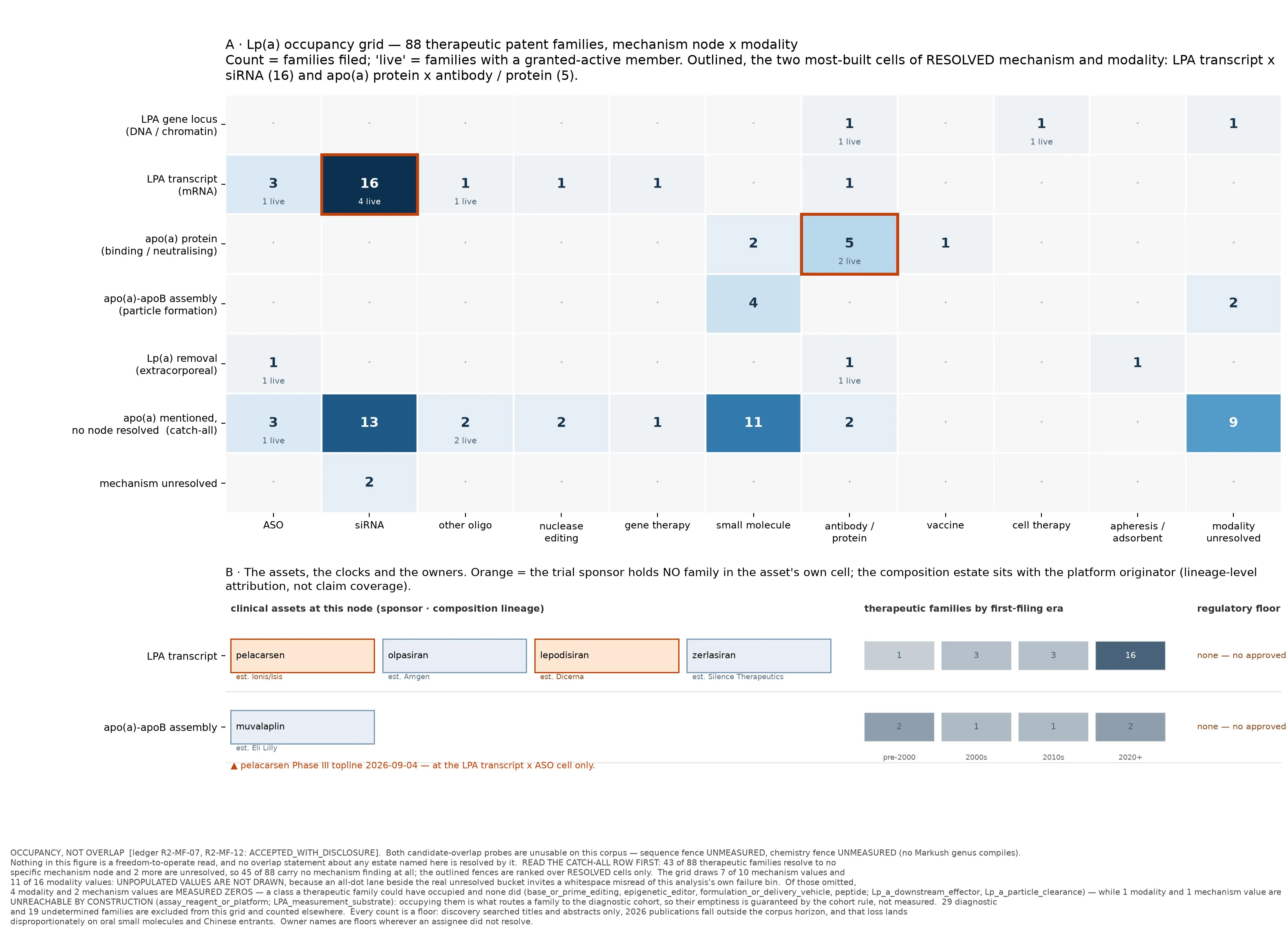
The sharpest finding is who owns what. For two of the five clinical assets, the composition estate sits with the platform originator rather than the trial sponsor. Novartis holds no composition family at the transcript node in this corpus at all — its on-target ASO family here is a measurement family, and pelacarsen’s composition lineage is Ionis’. Lilly holds no siRNA family whatsoever; the word lepodisiran does not occur anywhere in the corpus, that lineage being Dicerna’s. Amgen, Silence and Lilly’s oral program each stand on their own IP estate.
That is the part I would want in front of me in a diligence meeting, and it generalizes well beyond this target. A repricing event does not settle evenly on the names in the press release. It settles on the chemistry, and the chemistry here is owned, in two of five cases, by a company that is not running the study and may not be in the room when the result is discussed. The practical consequences run both ways. A sponsor can be less exposed than its own pipeline slide implies, because the estate it is standing on was licensed in and the licensor carries much of the structural risk. And a company with no trial reading out, no press release to issue and no investor call scheduled can have its most valuable estate revalued by somebody else’s Monday morning investor call. Anyone who has sat on the licensor side of an R&D program they no longer control will recognize the feeling.
Muvalaplin’s node is the useful exception. The assembly node holds six families, four of them small-molecule — genuinely thinner than the transcript node, and genuinely insulated, because a result about lowering Lp(a) by degrading its messenger says nothing directly about blocking the particle from ever assembling. Read as a verdict on lowering Lp(a) at all, the 4th of September announcement reaches every family on the map. Read as a verdict on one chemistry at one node at one exposure, it barely reaches muvalaplin. Both readings were available that morning, and neither release reported a subpopulation result that would let an outside reader choose between them.
One discipline before the conclusion, because this is where such analysis most often oversells itself. We did not measure claim overlap between these estates in either direction — the sequence and chemistry comparisons both failed, for unrelated reasons set out in the full analysis. Structural occupancy is an observation about IP filing behavior, not clearance, and the honest word for an untested pair is untested. What the map supports is not a verdict on anyone’s freedom to operate. It is a change of the key questions.
That change is the whole payoff. Walking into a validated target, one’s instinct is to ask who else is working on this. The more useful questions are whose IP fence am I inside, who actually owns it, and what would have to be true for their bad day to become mine. Those are answerable from the patent record before a term sheet exists, and they are frequently answerable in a different direction from the pipeline table everyone else is looking at.
The key generalization is that genetic validation is not a consolidating force in intellectual property. It is a fragmenting one. A target that everyone agrees is real attracts every modality capable of addressing it, and each builds its own IP fence, at its own node, on its own timetable — sometimes in the name of a company other than the one running the trial. Interleukin-6, mapped the same way in the previous article, came out the other way round: that field concentrated into antibodies at two nodes rather than spreading across many. The structure is the finding, and it is not the same finding twice.
So clinical news does not arrive at a target. It arrives at a fence line. Confidence in a target and confidence in an asset are different quantities, and the genetics only ever underwrote the first. Most of us eventually live the morning when somebody else’s trial result turns up the spotlight on our own asset — we find out then, rather than at signing, whose IP fence we had been standing behind.