
The Fence Is There: Listening for the Shift
The twentieth article in the rDNA.ai biopharma BD&L series, and the third of three on patent fences around genetically validated targets, reads NLRP3 through the fence line analysis: therapeutic patent families placed on a mechanism-by-modality grid and read against regulatory clocks and ownership lineages.
Every few years a target arrives that the whole field agrees on before anyone has a drug. NLRP3 is one of those. It is the sensor at the head of the inflammasome, the assembly that converts a danger signal into mature interleukin-1β, and its genetics are about as clean as inflammation biology gets: gain-of-function mutations cause the cryopyrin-associated periodic syndromes, and blocking the downstream cytokine treats them. When Novartis reported in 2017 that canakinumab, an antibody against that cytokine, reduced cardiovascular events in CANTOS, the industry read the prize as atherosclerosis rather than rare disease, and platform companies were bought on that thesis: Novartis acquired IFM Tre in 2019, and Roche acquired Inflazome in 2020.
The NLRP3 thesis is still being partnered, but the newest dealmakers look different. On January 20 of this year Insilico Medicine, the Hong Kong-listed AI drug-design company, granted Hygtia Therapeutics, a Fosun-incubated biotech founded last August, half of the worldwide rights to ISM8969, an oral, brain-penetrant NLRP3 inhibitor designed on Insilico’s generative chemistry platform, for up to $66 million including $10 million up front. Insilico runs the Phase 1 trial, which dosed its first participant in June; Hygtia takes over after that. For a BD&L professional, the structure is the interesting part: a co-development split of global rights rather than an outright license, from an AI company that designed its molecule against a target the field validated long ago.
Every newly-designed molecule that tackles an established target faces the same question from a prospective partner: where, among the fences this field has already built, does it stand? That is the question the fence line analysis asks. Going in, my expectation was a chemical genus story: a validated target in a small-molecule field, therefore one crowded thicket of overlapping Markush claims. I will come back to how that fared.
The NLRP3 patent search refused to answer this question cleanly. We pulled 2,126 publications across 780 patent families and ended, after screening for direction and claim scope, with 341 therapeutic families whose claims we can read. On the usual two axes — where in the mechanism the agent acts, and what modality it is — the largest single cell holds 106 families, and its mechanism value is a catch-all: a claim that reaches the NLRP3 sensor and names no part of it. The biggest concentration in this patent set is a concentration of unresolved claims.
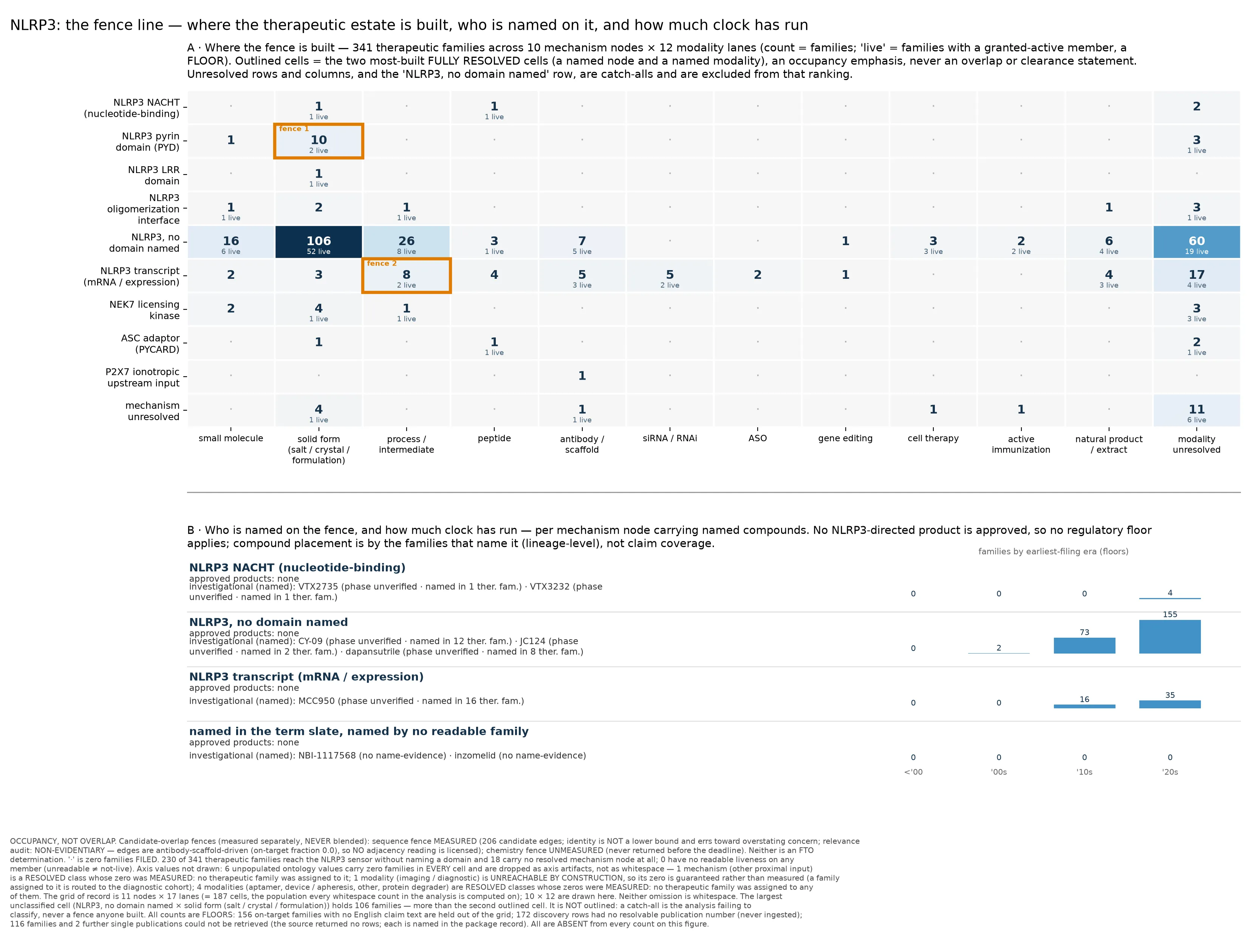
However, that is a result about the IP record, but not the target field. Of the 341 therapeutic families, 248 resolve to no specific structural node, and only 27 resolve to any of the sensor protein’s four domains. Fewer than one family in twelve says where on the protein it is claiming. This means that the NLRP3 patent record we can read is written at a coarser grain than the question a partnering team needs answered. Before correcting for that coarse grain, 64 cells looked readable as whitespace, 35 of them at a sensor domain. After it, not one readable whitespace cell remains at any sensor domain. The largest correction in the analysis moved in the direction of claiming less.
What survives is real, but it is not where the story was expected to be. Twenty-nine cells remain readable, and every one sits beside the sensor rather than on it: at the NEK7 kinase that licenses assembly, at the ionotropic upstream input, at the ASC adaptor, and at the NLRP3 transcript. Readable whitespace on this target is adjacent to the protein everyone is drugging, because adjacency is what the claims are willing to state.
Twenty-four cells resolve on both axes and hold 63 families between them, led by the pyrin-domain cell for solid forms (salts, crystal forms and formulations of compounds claimed elsewhere) at 10. Those are drawn fences. Whether any two of them enclose the same chemistry is a question this package could not answer: the chemical genus-overlap probe never returned, and the sequence probe returned but measured antibody scaffolds rather than NLRP3 scope. An unreturned probe is not a zero.
Ownership is thinner still. Three assignee groups resolve across the therapeutic cohort, covering 13 families — Roche, Novartis and Genentech, the acquirers rather than the originators — and the other 328 have no resolvable owner in this record. The newest entrants are the least legible of all. The IP estate holds one Insilico NLRP3 family, an international application filed in September 2025 and still pending; it sits outside the 341 because no claim text for it could be read here, and nothing in this record ties it to ISM8969. Anyone assessing a new entrant on this target should expect its patent position to be the last part of the record to arrive.
As for my expectation: the modality distribution does support calling NLRP3 a chemistry estate. A result that agrees with the analyst is not evidence that the analyst was independent. What makes it checkable is that the ontology and binning rules were fixed before the patent search ran, so a reader can see that the categories were not drawn to fit the answer.
One scope note. This analysis stops at the sensor and its immediate inputs; the terminal cytokine arm — caspase-1, gasdermin D, IL-1β and IL-18 — is out of scope by election. Inside that scope there is no exclusivity floor to clear, and that is a narrow statement: canakinumab, anakinra and rilonacept are approved on the arm elected out, in the same syndromes these patent families file on. The biology has marketed therapy; the sensor itself does not yet.
Three fence line articles have now shown three structures around three validated targets. Around IL-6 (Article 18) the fences concentrated; around lipoprotein(a) (Article 19) they fragmented. NLRP3 is the uncomfortable third: the fences are unmistakably there, but this IP record will not tell you where they run. An orchestra heard from the next room is like this. You can hear the melody clearly enough to name it, and tell that many instruments are playing, and still not say which specific ones carry the tune. But when a new player arrives, the sound shifts in register or clarity – a subtle thinning of the acoustic texture that signals to a partner there is still open air for a new instrument to pick up the melody and carry it forward.