
Knowing Whose Fence You’re Looking At
The sixteenth article in the rDNA.ai biopharma BD&L series reads CD38 through claimed antibody sequence overlaps and ownership records to identify candidate boundaries and who is across the table, without treating sequence similarity as an FTO opinion.
On April 20 of this year Biogen paid TJ Biopharma $100 million up front, with up to $750 million in milestones and a royalty on Greater China sales, for the Greater China rights to felzartamab, an investigational anti-CD38 monoclonal antibody in three pivotal Phase 3 trials in rare kidney disease. The sentence in the release worth noting is the one describing what the payment bought: Biogen now owns exclusive worldwide development and commercialization rights, consolidating global rights under one owner. Biogen also assumed the milestone and royalty obligations owed under the original licensing agreement with MorphoSys, which the release identifies, in a parenthetical, as currently a wholly-owned subsidiary of Novartis.
For a BD&L professional, that sentence closes a file. The question that follows, however, is not “what did Biogen buy” but rather “who else is nearby in anti-CD38 clinical development?”. And the usual way to answer that question is to pull the patent record for the target, sort by assignee, and assemble Biogen’s neighbors.
On this asset, however, that method does not merely fall short. It returns the wrong answer.
Felzartamab has been through four transactions in four years. MorphoSys licensed it to Human Immunology Biosciences (HIBio) in June 2022, worldwide except for Greater China, taking an equity stake, milestones and royalties. Novartis agreed to acquire MorphoSys in February 2024. Biogen then agreed to acquire HIBio in May 2024 for $1.15 billion up front and closed the acquisition that July. Finally came this April’s purchase of the Greater China rights from TJ Biopharma, the piece the original license had carved out. One molecule, four deals, and at the end of it an asset is controlled worldwide by one company, with success-related payments owed to another.
BD&L looks first at the patent record for CD38. Biogen, which owns the asset outright, does not appear as the assignee on any anti-CD38 antibody family in the corpus, including the estate felzartamab came from. Its only appearance anywhere is an unrelated legacy filing on CD23 under the Biogen Idec name, retired in 2015. HIBio, which developed the asset for two years, does not appear anywhere. Neither does TJ Biopharma. Novartis does not appear either, except as a corporate suffix: the IP estate reads MorphoSys AG, MorphoSys Inc, and — on one recent family — MorphoSys GmbH, which is the post-acquisition Novartis entity. Any IP ownership tool that rolls those three spellings into one sponsor is correct as a matter of chain of title and actively misleading as a matter of who you would want to be aware of.
A clear demonstration of the ownership gap comes from Biogen’s own language. In a November 2025 press release ahead of Kidney Week, the standard paragraph describing felzartamab notes that HIBio licensed rights in all countries excluding China, Macau, Hong Kong and Taiwan. Five months later Biogen bought exactly that carve-out. The rights chain moved inside one company’s routine boilerplate in a single quarter. But the assignee field did not move at all.
The obvious objection to such forensic investigation is a good one, and any patent attorney will raise it immediately: the front page of a patent is a snapshot taken at issue, and ownership changes are recorded separately. So a BD&L professional next checks the assignment records. So we did. Across all 39 US publications in the eighteen MorphoSys CD38 families there are 35 recorded assignments, and every one of them names MorphoSys AG as the recipient. Twenty-nine are ordinary inventor-to-employer assignments and six are a single housekeeping recordation from 2017. There is no recorded transfer to Novartis, to Biogen, to HIBio, or to TJ Biopharma anywhere on the CD38 IP estate.
By itself that would prove very little, because absence in a database is usually a fact about the database. It is not, here, and the checks that establish it are worth stating. MorphoSys records assignments to Novartis routinely — 110 of them across 83 patents, running through February of this year — but they cover sclerostin, TREM2, ENTPD2 and myostatin, which are the assets of the longstanding research alliance between the two companies rather than anything to do with the acquisition, and none of them touch CD38. MorphoSys also recorded its own corporate rename, from AG to GmbH, against sixteen patents in late 2024, and the CD38 estate was not among them. Biogen has recorded more than five thousand assignments across two thousand patents, most recently this April. TJ Biopharma’s parent records too. Every party in this chain is a demonstrably active user of the recordation system. None of them appears on this estate.
The precise finding is that there is no recorded assignment, which is not the same as no assignment. Legally, a transfer is effective between the parties whether or not anyone records it; recordation governs priority against later purchasers. The register is not wrong. It is silent, and reading silence correctly is the whole skill.
Two dates make the point better than the summaries do. The family covering the treatment of anti-PLA2R autoantibody-mediated membranous nephropathy — the indication behind one of the three pivotal trials Biogen is now running — took an inventor assignment that was recorded on May 13, 2024, nine days before Biogen announced the HIBio acquisition, to MorphoSys AG. And the most recent recordation anywhere on the estate, from January 2025, also names MorphoSys AG: a company that had legally become MorphoSys GmbH seven weeks earlier.
In reality, what MorphoSys holds is larger than the one foundational family, and more formidable. Eighteen families, three of them titled to the exact indications of Biogen’s pivotal program — one to antibody-mediated graft rejection, two to membranous nephropathy — all filed in the first half of 2022, at or just before the HIBio license was signed by MorphoSys. Whatever those three turn out to cover, they were drafted and filed before any of this belonged to Biogen, and they are still recorded to the company that drafted them. And the CD38 estate is still growing under the Novartis-era name: a new family on concentrated antibody formulations was filed in January 2025 by MorphoSys GmbH, six months after Biogen closed the HIBio acquisition and took rights everywhere but Greater China.
None of the ownership or assignment records tells you where the boundaries of the CD38 field are. For that you have to compare what the patents actually claim, and for antibodies that means comparing claimed sequences rather than chemical structures. We ran every claimed antibody sequence in the CD38 corpus against every other, which is 2.9 million possible pairings, and pushed the survivors through a deliberately narrow gate: constant regions stripped out, the shared CD38 antigen held aside, short alignments discarded, and — the step that matters most — a requirement that both sides had actually claimed the matching sequence, not merely disclosed it somewhere in the specification. Forty-seven pairs survive. Everything above that number is a lower bound, because a pre-filter discarded roughly 85 percent of possible pairs without ever aligning them, and a pair that was never tested is not a pair that was cleared.
Next we partitioned those 47 by who owns the two sides, and the number that matters appears. Five of them are one sponsor overlapping its own estate, which is not a competitive boundary at any level of similarity. Thirty-five are genuine overlaps where at least one side’s corporate identity is an unresolved name match rather than a confirmed company. Seven are cross-sponsor and attributable. What is the answer to “who else is nearby in anti-CD38 clinical development?” – the seven of 47. That is the entire population of structural questions on this target that BD&L should take to counsel and name both parties.
The figure below is the whole exercise on one page. Every filled cell is a pair of estates whose claimed sequences align; the number printed in the cell is the identity, and the colour is the ownership partition rather than the identity, so that no cell can be ranked by how alarming its number looks. Read the colour first and the number second. That ordering is the point: an intense number in a same-sponsor cell is a company overlapping itself, and a moderate number in a cross-sponsor attributable cell is a real question for counsel.
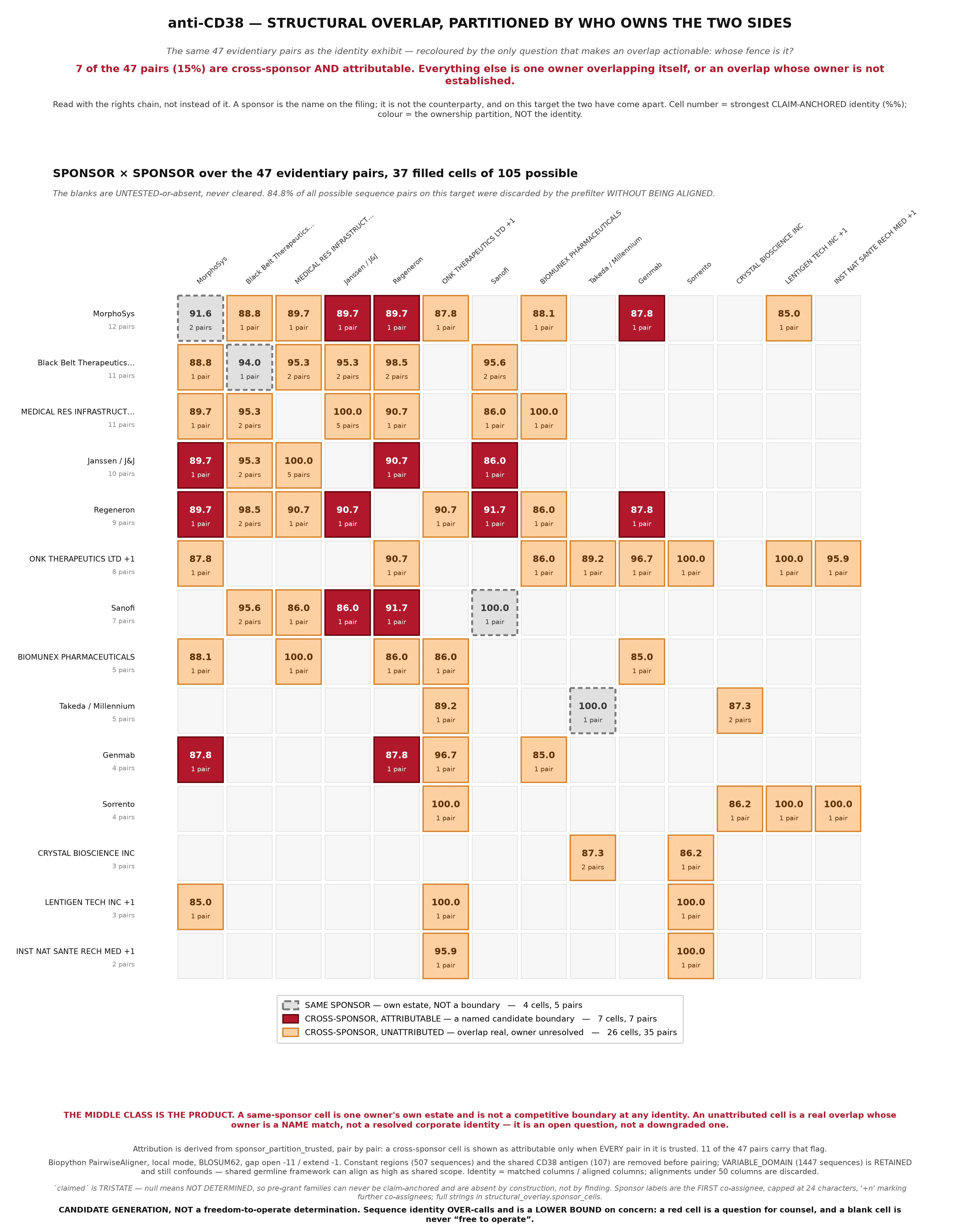
On the MorphoSys IP estate specifically, ten pairs reduce to two of its own, five unattributed, and three attributable neighbors: Janssen, Genmab and Regeneron. Three edges, not ten — and the discipline that produces the three is what makes them useful. It also protects against the trap immediately behind them, which is real and which we nearly walked into. The summary cell for the MorphoSys and Janssen relationship reads 90 pairs, fifteen claim-anchored, maximum identity 100%. Quoting that would be wrong three ways over: the 100% belongs to a different pair than the anchored ones, the alignment is short enough to be shared germline framework rather than shared scope, and the cell mixes categories. The evidentiary answer is one pair at 89.7%. The gap between fifteen and one is the most instructive number in this analysis: a convenient tool hands you the fifteen, and a useful one hands you the one and shows its work on the fourteen it set aside.
So, if IP ownership and recorded assignments are inconclusive or misleading, how does BD&L identify who is on the other side of Biogen’s CD38 fence? Not by treating any of this as a freedom-to-operate opinion, which it is not. Sequence identity over-calls by construction — it errs toward flagging things — so a high-identity pair is a question rather than an answer, and an empty cell is never clearance, only a pair nobody has tested. What the exercise buys is scope. Before engaging counsel you can say which neighbors are real, which are the seller’s own estate, which cannot be attributed to anyone yet, and which of the names on the filings still describe a company that exists under that name. The supporting analysis for this read is posted at rDNA.ai, alongside the earlier articles in this series: the funnel at each gate, the estate-by-estate breakdown behind the seven, and the recordation audit with its reel and frame numbers, including the counter-checks that establish the silence on this estate as a finding rather than a gap.
Meanwhile the clock runs. The pivotal trial in antibody-mediated rejection finished recruiting by the middle of this year and reads out in 2027. The CD38 IP estate it rests on was first filed in October 2006 and is still being extended. And the name on it belongs to a company that has not existed independently since 2024.
There is an old distinction in property work between the deed and the fence, and the useful thing about it is that the two documents are maintained by different people on different schedules. Structural analysis will show you where the fence lines run. It will not tell you whose fence it is. In a field where an asset can pass through four owners in four years while the survey markers stay exactly where the original surveyor drove them, that second question is not a refinement. It is most of the work. To infer the neighbors to an IP estate on the basis of ownership and assignment only is akin to assessing the strength and durability of a fence by checking its color.