
Telling Fallow Ground from Ground Nobody Walked
The fifteenth article in the rDNA.ai biopharma BD&L series reads the TYK2 target class through whitespace and trajectory analysis, separating fallow ground from cells that only look open because they were never measured.
On June 11 of this year Takeda reported that its once-daily oral drug zasocitinib had beaten Bristol Myers Squibb’s deucravacitinib head-to-head. In LATITUDE Atlas, a 606-patient Phase 3 trial in moderate-to-severe plaque psoriasis, zasocitinib was statistically superior on the primary endpoint of complete skin clearance at week 16 and on all key secondary endpoints, with more than 35 percent of patients reaching complete clearance — more than two and a half times the rate on deucravacitinib, with the curves separating as early as week 8. Takeda intends to begin filing for approval this fiscal year. The drug is not approved anywhere yet.
Both molecules work the same unusual way, and that is what makes the result worth a BD&L professional’s attention. On September 9, 2022 deucravacitinib became the first drug to reach the market by binding a kinase’s regulatory pseudokinase domain rather than its catalytic site. In December of that year Takeda paid four billion dollars up front for Nimbus Therapeutics’ TYK2 programme, which does the same thing. A structural idea that had been a medicinal-chemistry curiosity became, in a single quarter, both a marketed product and the most expensive preclinical asset in immunology. Less than four years later the follower has outperformed the pioneer on the pioneer’s own endpoint.
What the Nimbus pivot did to the patent record is the interesting part, and it is not what an outsider would guess. The field did not spread out into the new territory the pivot opened. It piled into two cells and stayed there.
This is the eighth target we have run through the whitespace and trajectory layer described in the tenth article in this series, and it is the one that teaches the most about the difference between ground lying fallow and ground that nobody has walked across.
Sixty term-sliced discovery calls across the United States, Europe, the international Patent Cooperation Treaty route and China returned 383 distinct rows. 201 of those were queued for ingest, 188 completed, and thirteen failed outright and are named as failures rather than quietly dropped. That produced 279 patent families. A per-family read of the actual claims then reclassified 51 of them off this pathway — a string collision with a differently named kinase accounts for several, and the single largest structural position in an early draft of this analysis turned out to be a TTK inhibitor that never recites TYK2 anywhere in its claims. What remains is 228 families, and that number is an upper bound rather than a floor, because 35 of them are admitted on programme or title inference rather than on a claim that names the target.
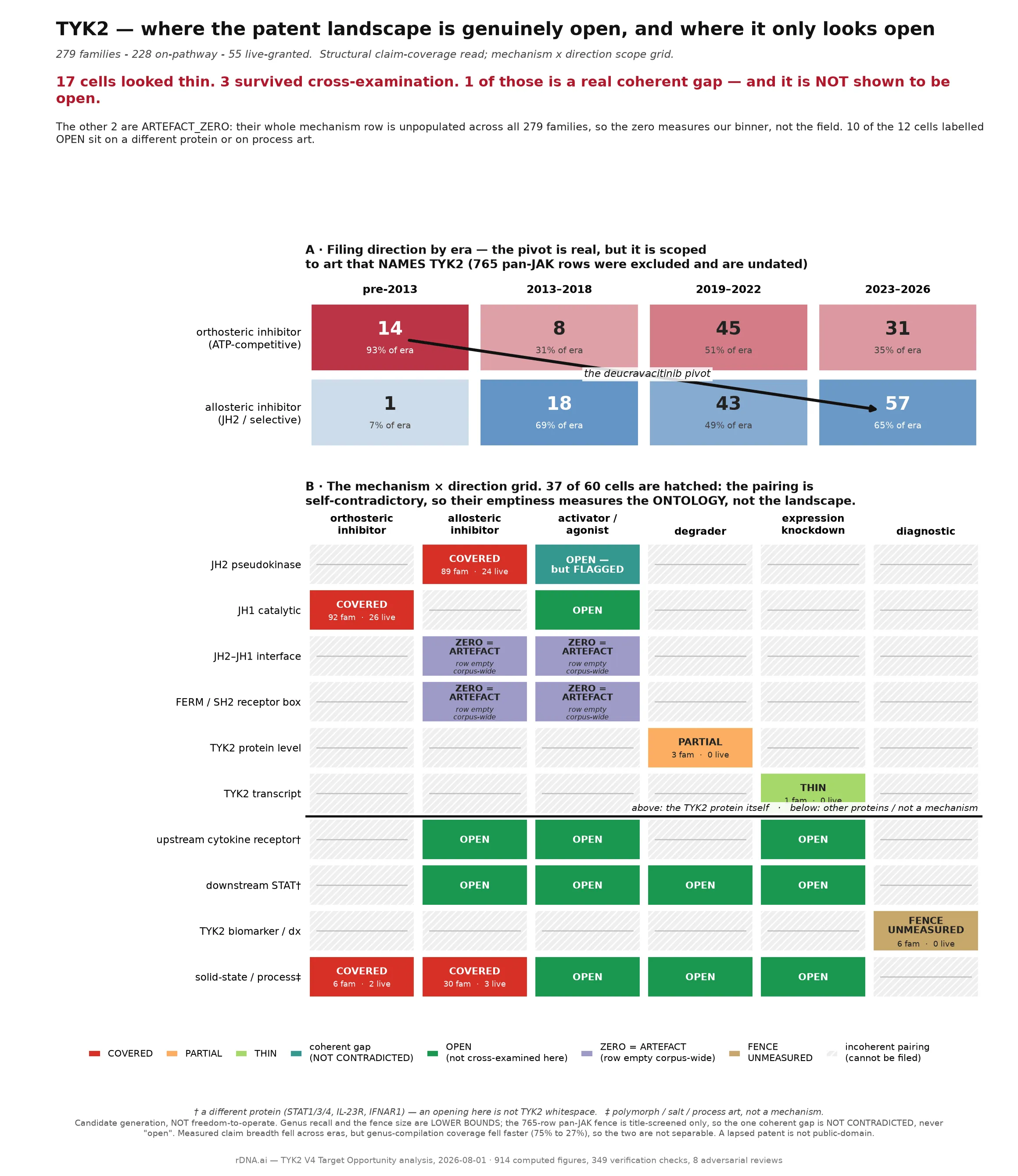
The upper panel of the figure is the pivot itself, cut on real filing dates. Families claiming catalytic-site inhibition against families claiming allosteric inhibition run fourteen to one before 2013, then eight to eighteen, then 45 to 43, then 31 to 57 in the current era. The two directions reach parity in the 2019 to 2022 band and the order reverses after it, which puts the moment the record stopped favouring catalytic-site chemistry a few years ahead of the 2022 approval that vindicated the alternative. Nobody had to wait for the label to know which way the chemistry was going; the claims said so, on real filing dates.
The lower panel is where it stops being a growth story. The coordinate system has ten mechanistic nodes and six claim directions, 60 cells in all, of which 23 are pairings that can actually be filed against and 37 are combinations that make no mechanistic sense — a degrader of a receptor box, for instance. Emptiness in those 37 measures our vocabulary, not the landscape, and they are drawn hatched for exactly that reason. Of the 23 coherent cells, seven carry art at all. Two of those seven hold 79.7% of the 227 families the grid could place: catalytic-site inhibition at 92 families and 26 live grants, and pseudokinase-domain allostery at 89 families and 24 live grants. Twenty-five families across the whole corpus hold a structural claim above our breadth threshold and are live and granted somewhere. That is the fence, and because our breadth measure is a lower bound the real fence is taller.
The ownership pattern inside the allosteric cell is worth a paragraph on its own, and June 11 of this year sharpened it. Bristol Myers Squibb, which got there first and got approved, holds ten of the 89 families. Sudo Biosciences holds nine. Nimbus holds nine and Takeda holds seven, with no overlap between the two sets, so if you treat the announced 2022 transaction as having moved the Nimbus estate — an external fact about a deal, not something the assignee field tells you — Takeda, as acquirer, now holds sixteen families in that cell, more than the company with the marketed drug. The concentration was in the filing record years before the trial read out. Two cautions come with it. The Nimbus families arrive under three different assignee strings, one of them a misspelling of the subsidiary’s own name, which is a reminder of how much a name-based rollup understates a position. And fourteen of the 228 families carry no usable assignee string at all.
Next comes the part that changes what this means. We built the coordinate system before placing anything on it, and then widened the mask of pairings we were willing to treat as coherent, which is the move most likely to manufacture whitespace out of nothing. Seventeen cells came back thin or empty. We cross-examined fourteen of them and left three unexamined, which we say rather than rounding up to “all of them”. Of the fourteen probed, four proved to be occupied by art outside this corpus, four had never been searched by any discovery slice, and three sit downstream of a cell already too thin to support them. Three survived.
An adversarial review of the write-up then took two of those three away. Both sat in mechanism rows that are unpopulated across all 279 families in the corpus — not thin, not contested, unpopulated, in every direction. A row like that tells you the binner has no vocabulary for that node. It tells you nothing whatever about whether the art exists. The grid raw-labels twelve cells as open, and once cells describing downstream signalling proteins, upstream receptors and crystalline-form process chemistry are set aside, two of those twelve are on the TYK2 protein at all. Every correction in that review ran in the same direction, against the opportunity, and none ran the other way.
So the honest count for this target is one candidate cell, not three: a TYK2 activator at the pseudokinase pocket, the mirror image of everything else in the field. The supporting evidence is thin in a specific and instructive way. We title-screened 519 pan-JAK patent families that sit outside the TYK2-labelled set, and none of the 519 names TYK2. The one vocabulary match was on the word “activator”, and no title in the set contains the word “agonist”. Weak evidence of absence is not evidence of opportunity, and the correct next step is not a screening campaign but ingesting those families so their claim scope can be measured rather than guessed at. The cell is not contradicted. It is not open.
Two further readings belong in the record because they cut against a tidy story. Measured claim breadth does fall across the eras, peaking on our recall measure at 0.643 in the 2013 to 2018 band and ending at 0.279, which is 43% of peak. But the share of families for which a genus can be compiled at all falls from 74.1% to 26.7% over the same span, so the newest era’s breadth figure rests on a quarter of its cohort. A maturing field narrowing its claims and a measurement that is quietly failing look identical in that slope, and on this data they are not separable. Likewise on liveness: 149 of the 228 families have a readable legal status and 55 are live and granted, which leaves 79 that are unreadable rather than dead. Reading unreadable as expired would have written off a third of the landscape.
What the patent record could not have told anyone is which of two molecules binding the same pocket would clear more skin at week 16; that is what LATITUDE Atlas was for. What it did tell you, several years earlier, was that the pocket had become the field’s centre of gravity and that the deepest position on it was accumulating outside the company that got there first.
There is a version of this analysis that reports three opportunities on TYK2, and it is the version that stops before asking whether each empty cell was ever measured. A field lying fallow and a field nobody has walked across look the same from the road, and the difference matters more than anything else you can see from there: one of them tells you something about the soil, and the other tells you only how far you have travelled. The supporting analysis for this read is posted at rDNA.ai, alongside the earlier articles in this series.