Crowding the Vineyard’s Southern Slope
On a target with five therapeutic formats and two decades of prosecution, PCSK9 shows why patent density on the established surface says little about where the next drug will act.
On July 16th the FDA approved LIPFENDRA, Merck’s enlicitide tablets, the first oral PCSK9 inhibitor — a macrocyclic peptide that blocks the interaction between PCSK9 and the low-density lipoprotein (LDL) receptor. In Merck’s own account of the registrational program it lowered LDL cholesterol by 56% against placebo in CORALreef Lipids and 59% in CORALreef HeFH at twenty-four weeks. Merck is equally careful about what is not yet known: the cardiovascular outcomes trial, CORALreef Outcomes, has more than fourteen thousand patients enrolled, has not read out, and is expected to complete late in 2029. Nothing below depends on that answer.
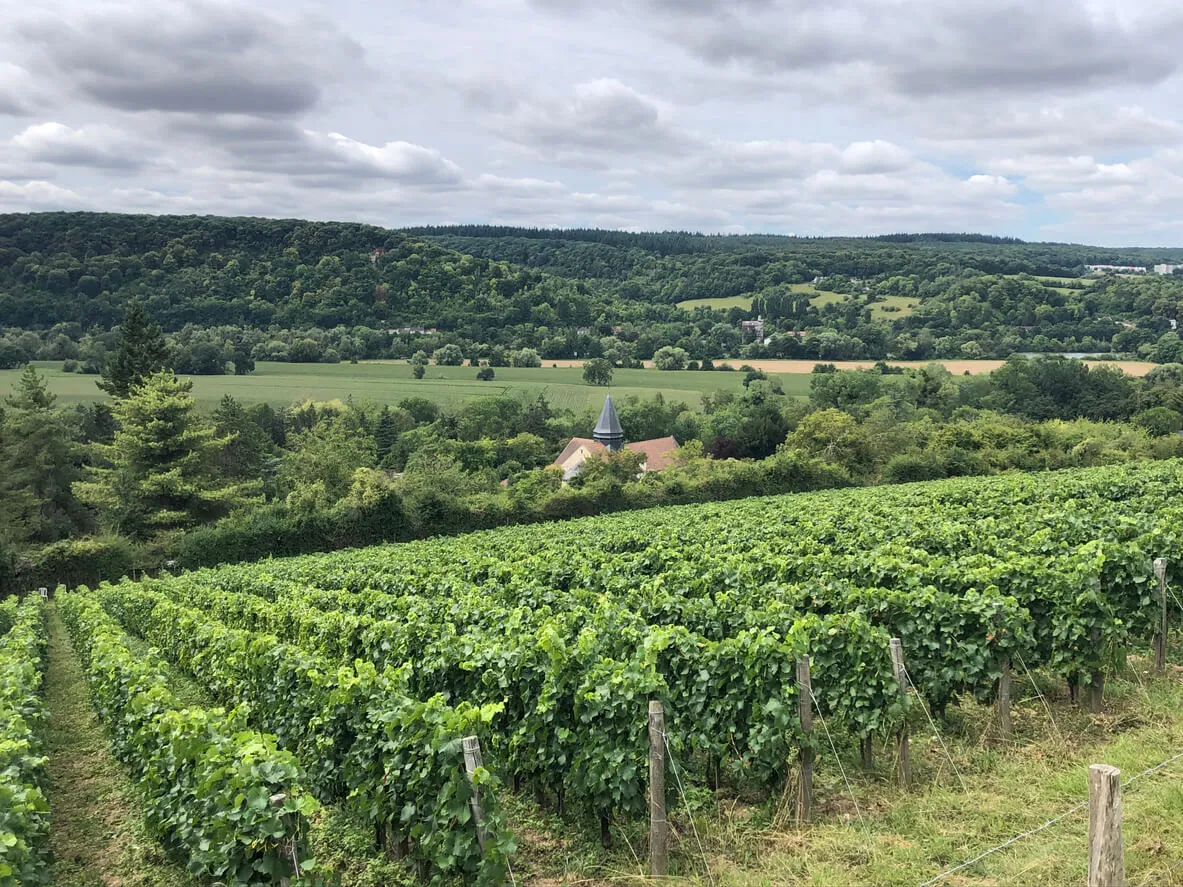
What interests me is not the approval. It is what the approval says about where a whole field put its patents for fifteen years — the way Burgundian growers packed vines ever tighter onto the same storied mid-slope parcels, on excellent evidence, right up until the climate moved.
PCSK9 has been attacked in five distinct formats — monoclonal antibodies, small interfering RNA, antisense oligonucleotides, vaccines, and now oral chemistry, with gene and epigenetic editors arriving behind them. Most targets get two formats and a graveyard. So PCSK9 is a good test of a question a BD&L professional and an inventor ask differently but at the same moment: on a target this well-worked, is there anything left, and if there is, how would you know?
We ran it through the whitespace and trajectory layer described in the tenth article of this series. Seven hundred and eighty distinct discovery rows resolved into two hundred and ninety-one ingested patent families, of which two hundred and eighty genuinely claim a PCSK9 mechanism once each family’s claims are read rather than its title. The mechanistic coordinate system was built first, from the protein and gene records and the peer-reviewed literature, and human-reviewed before a single family was placed on it. That order matters: derive the mechanism axes from the patents and every empty cell you find is an artifact of what happened to be filed.
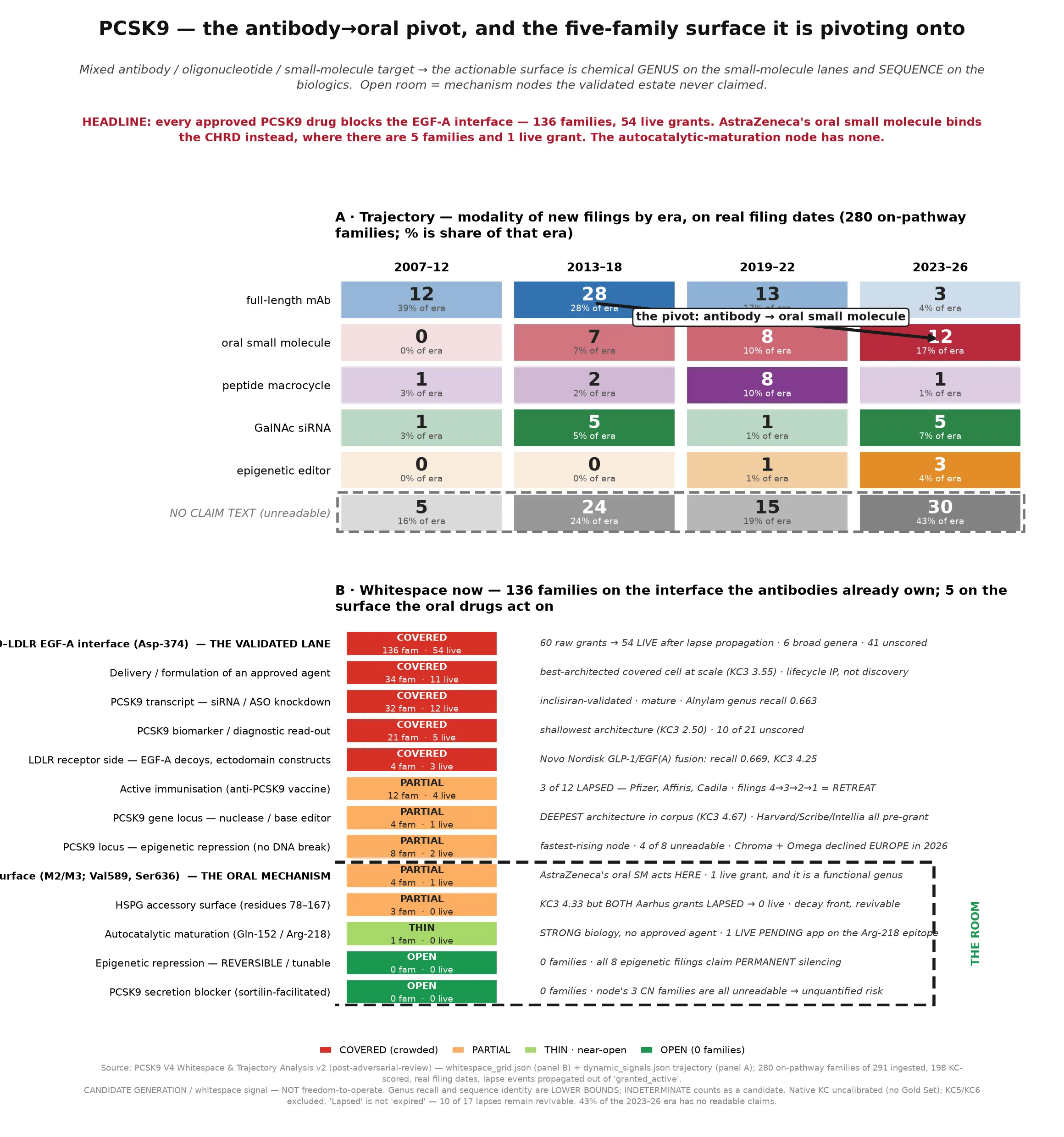
The upper panel is the trajectory, by format, on real filing dates rather than publication proxies. Full-length antibody families run twelve, twenty-eight, thirteen, then three across the four eras — a ninety percent collapse from the 2013–2018 peak. Oral small molecules run zero, seven, eight, twelve, the only strictly rising therapeutic format in the set, and in the current era they outnumber the antibody four to one in new families. Behind both, epigenetic editors go from nothing to seven families on the locus in four years. The grey dashed row across the middle of that panel is the one every landscape figure should carry and most do not: the share of each era with no claim text at all. In the current era it is thirty of seventy families. Forty-three percent of the frontier cannot be read, and it cannot be read in a jurisdiction-specific way, so every count there is a floor rather than a measurement.
The lower panel is where that leaves the room to build, and it contains the finding.
Every PCSK9 agent approved in the United States — the two antibodies, the small interfering RNA, and now the oral peptide — acts on the same surface: the EGF-A groove around Asp-374 where PCSK9 grips the LDL receptor. In the patent record that surface carries one hundred and thirty-six families and fifty-four live grants, with six broad compiled-genus positions across it, held by Regeneron, Merck, Amgen, Sanofi and a substantial cohort of Chinese followers. It is the mechanism litigated to the Supreme Court in Amgen v. Sanofi, and by any structural measure it is thoroughly fenced.
Now look one row down. AstraZeneca’s granted oral small-molecule patent does not define its compound by a scaffold. It defines its inhibitor by a binding pocket, named by two PCSK9 residues, Val589 and Ser636. Both of those residues sit in the C-terminal cysteine-and-histidine-rich domain, not in the EGF-A groove — we checked the residue positions against the UniProt record for the protein rather than taking the claim’s word for it. The second-generation oral mechanism, in other words, acts on a different surface from every drug that has ever been approved against this target.
That surface carries five families and one live grant.
One hundred and thirty-six against five, on the same protein, is the sort of asymmetry worth several weeks of somebody’s time. It is emphatically not an invitation, and the interesting part of this analysis is why not. The single live grant on that surface is not a chemistry claim at all — it is a functional claim, a pocket plus a binding constant, broad in one direction and fragile in another. AstraZeneca’s actual structural position there is either pre-grant, in a published application covering eight hundred and eighty-three compounds whose compiled genus reaches only about a third of the analog space it gestures at, or unreadable, in a 2025 international filing that entered our corpus as a bibliographic record with no claims. And until the twelfth of May this year the surface carried two functional-genus grants, not one: a 2009 patent from Montreal’s IRCM claims any polypeptide ligand binding this domain or its M2 subdomain, and it lapsed for non-payment in May.
Which brings up the distinction this kind of work lives or dies on. Lapsed is not expired, and expired is not public domain. Seventeen non-payment lapses sit on this target’s on-pathway families, and ten of them — including that Montreal patent and both of the University of Aarhus grants that were the only granted coverage on a third PCSK9 surface — are recent enough to remain revivable on petition. A landscape tool that renders a lapse as a green cell is not conservative enough to be useful. Ours prints the date and lets you count the months.
The rest of the room is smaller and more honest than the headline. The autocatalytic maturation step, where PCSK9 cuts itself to become active, has one family and no live grant against the strongest literature support of any thin cell we found — but that one family is a live pending application claiming an antibody to the epitope ending exactly at the furin cleavage site, so nobody should call the step untouched. The epigenetic locus is the fastest-rising node, and not one family on it claims reversible rather than permanent silencing — but four of its eight families cannot be read, two sponsors, Chroma Medicine and Omega Therapeutics, declined the European regional phase this spring, and the reasoning that identified that gap also suggests one of those sponsors’ own filings may belong inside it. We wrote that objection into the finding rather than around it.
The synthesis is simpler than the mechanism detail. On a target with five formats, two decades of prosecution and three approved drugs, patent density measured on the validated surface tells you almost nothing about the surface the next drug will use. The chemistry moved and the estate did not follow, and the move shows up in the filing dates well before it shows up on a label. Reading that requires the whole class rather than the asset, a coordinate system built before the patents are placed on it, and a discipline about what the record does not say — the unreadable frontier, the revivable lapse, the compiled genus that returns “indeterminate” for sixty-one percent of its overlap tests, which are precisely the tests a design-around question would turn on. The supporting analysis for this read is posted at rDNA.ai, alongside the earlier articles in this series.
A domaine with generations of vintages off the same parcels has excellent reason to trust them, and those rows are the most valuable thing it owns. It is also the last on the hillside to notice that the interesting fruit now comes from higher up — the cooler ground that was never worth fencing, until it was.