
Cross-Examining What’s NOT in the Evidence
The thirteenth article in the rDNA.ai biopharma BD&L series examines the ACTH receptor (MC2R) landscape through the forward-looking whitespace and trajectory layer, testing whether apparent absences in the patent record are actual opportunity.
On July 6 of this year, Vertex agreed to acquire Crinetics for $85.00 per share in cash — roughly $10.0 billion of equity value, or $8.8 billion net of cash. The shareholder vote hasn’t yet been held, so nothing below assumes it completes, and Crinetics brings a launched acromegaly product with it, so the Phase 3 asset isn’t everything Vertex is getting. But that asset is atumelnant, an oral antagonist of the adrenocorticotropic hormone (ACTH) receptor — the melanocortin subtype-2 receptor (MC2R) — in congenital adrenal hyperplasia (CAH). As it happens, MC2R is about as narrow a target as the industry currently writes that kind of cheque against.
Narrow targets are a useful stress test for landscape work, because the record is small enough that every gap in it stays individually visible. So we ran MC2R through the whitespace and trajectory layer first described in the tenth article in this series, and then did the part that matters most: we cross-examined every landscape cell that came back empty.
Twenty-five patent families were ingested, and twenty-three were genuinely on this pathway — the two that dropped out arrived on a term collision. Ninety members, with real filing dates from April 1992 to August 2025. As in the PCSK9 whitespace analysis, the coordinate system was built first, from the protein and gene records, the structural literature and the disease genetics, and human-reviewed before a single family was placed on it.
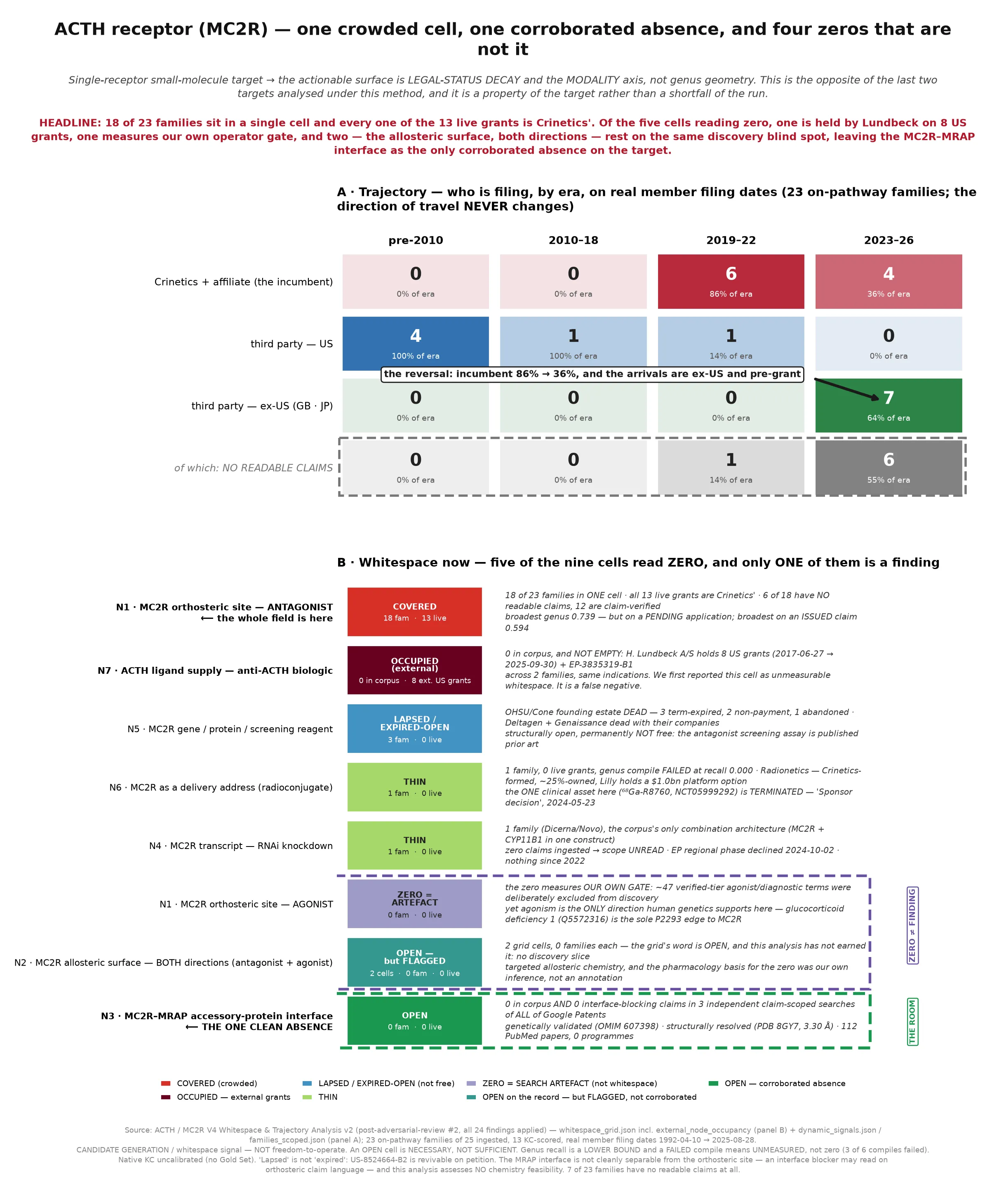
The upper panel is the trajectory, cut on real filing dates and split by who was filing. The incumbent row — Crinetics plus its affiliate Radionetics — runs zero, zero, six, four across the four eras. Third-party US filers run four, one, one, zero; three of the four in the first era were not MC2R-specific investments at all — an academic cloning estate, a knockout-mouse programme, a haplotype library — and the fourth was a screening-library vendor’s 2006 composition claim to MC2R inhibitors, filed twelve years before the incumbent’s first non-provisional and never nationalised anywhere, so no exclusive right ever issued from it. All four are dead; the last survives as prior art. The third row, third parties outside the US, runs zero, zero, zero, seven: six from OMass Therapeutics in the United Kingdom and one from Scohia Pharma in Japan, a 2017 carve-out from Takeda. The incumbent’s share of new families reverses, and the direction survives seven alternative era boundaries and an equal-count quartile cut — 80–100% incumbent in the penultimate era under every scheme tested, 22–43% in the final one. Treating Radionetics as a third party, which is defensible because it is affiliated rather than controlled, takes the final era lower still.
The grey row underneath is the one I would refuse to read a landscape figure without: families with NO readable claim text from any source. It runs zero, zero, one, six. Seven of the twenty-three families sit here, 30% of the record, and cannot be read at all; re-ingest provably does not repair it, and six of the seven are one sponsor — OMass, whose MC2 programme has a named development candidate but no registered clinical trial in the public record. Scohia is the second live non-incumbent programme and its claims can be read. Every comparative statement about how the new entrants stand against the incumbent is blocked on that gap rather than answered by it.
The lower panel is the whitespace map, and it is where the cross-examination happened. Eighteen of the twenty-three on-pathway families sit in one cell, orthosteric antagonist, and all thirteen live grants belong to Crinetics: ten US, two European, one Chinese — though the European grants carry per-state pruning and the Chinese liveness rests on grant notices with no post-grant maintenance evidence. Five other cells read zero. Exactly one of the five meant what a zero appears to mean.
The most instructive failure was the ligand-supply cell: rather than block the receptor, neutralise the circulating hormone. Our first pass called it empty and flagged it unmeasurable, reasoning that an antibody against a seven-transmembrane receptor is a hard format. That was sound and irrelevant, because the play here is against the ligand. Adversarial review found the cell occupied outside our corpus, so we ingested the families and re-verified from primary records: H. Lundbeck A/S (Lundbeck) holds eight US grants issued between June 2017 and September 2025, plus a European grant from November 2025, across two anti-ACTH antibody families, the earliest of them issued to Alder BioPharmaceuticals, which Lundbeck acquired in 2019. Claim 1 of the most recent US grant is a method of reducing cortisol, aldosterone or corticosterone with an anti-human-ACTH antibody, and its dependent indication claims recite the same indication set as the corpus we had just finished characterising. A cell we had labelled an absence holds the only granted estate on this target that is not the incumbent’s. Its post-grant status isn’t verified, and we say so.
Three of the remaining four zeros collapsed once questioned. The agonist direction reads zero because our own operator-defined search excluded the agonist term list outright — and that cell is less open than old, since cosyntropin, tetracosactide and corticotropin are marketed ACTH-receptor agonists whose composition patents expired decades ago. The allosteric surface, which is two cells rather than one, reads zero because no discovery slice ever targeted allosteric chemistry. Both rest on the same blind spot that produced the ligand-supply false negative, and the figure prints them in different colours because the reasons differ: one says the zero measures our instrument, the other says open on the record and not corroborated.
That leaves the interface between MC2R and its melanocortin-2 receptor accessory protein (MRAP) as the only zero that survived. Three independent claim-scoped searches of Google Patents returned no interface-blocking claim, the phenotype is genetically validated, and the complex is resolved at 3.30 ångström. Three things sit on top of that, and the analysis states them rather than implying them away. The accessory protein’s extracellular region stabilises bound ACTH, so an interface blocker may read on orthosteric-antagonist claim language as a matter of construction. MRAP modulates all five melanocortin receptors, so the selectivity problem is inherited rather than escaped. And nothing in a patent-record analysis tests whether the interface is druggable — part of why nobody has claimed it may be that nobody can do it.
The same discipline cut into the crowded cell. Its headline genus recovers at least three-quarters of the analog space it gestures at, but that number sits on a pending application, and the two granted siblings in the same family did not compile at all: their genera came back failed, which means unmeasured, not narrow. Three of six compiles here failed. The broadest fence actually measured on a granted claim recovers at least six-tenths, and recall is a lower bound throughout, so the honest output is an order in which to attempt a design-around rather than a difficulty rating. The crowded cell has a lower bound of its own that we could not close: a 2022 report from LifeArc and Queen Mary University of London describes a small-molecule MC2R antagonist selective among the human melanocortin receptors, and we found no patent family for it in our corpus or in a targeted sweep. The cell called covered is itself a floor.
In the end, the most actionable item on this target is not chemistry. A method-of-use patent filed in 2011 by the University of Denver and granted in 2013 claims treatment of cortisol overproduction with an agent that inhibits MC2R without inhibiting the other melanocortin receptors — the functional selectivity limitation intact, narrowed only by a proviso to two short peptides. Its maintenance fee went unpaid with effect from September 3, 2025. It is lapsed, which is not expired: it remains petitionable, with no hard bar, and its anticipated expiration is 2031. Someone tried to own the mechanism as a method and let it go, ten months before the incumbent was valued at ten billion dollars.
None of that insight came out of the crowded landscape cell. It came out of the empty ones, and four of the five were empty for reasons that had nothing to do with opportunity. Whitespace analysis is worth no more than its willingness to treat its own zeros as claims requiring proof. In practice this means naming the search you did not run, the format you dismissed for the wrong reason, the estate you found only because a reviewer looked outside your corpus, and the 30% of the record you cannot read. The supporting analysis for this read is posted at rDNA.ai, alongside the earlier articles in this series.
The very first article in this series was about absence as evidence. This one is about the harder half of it — evidence of absence. A silence in the record is not a silence in the world, and separating the two takes the second question rather than the first: not whether something is there, but whether anyone looked. Landscape tools answer the first question by default, and answer it confidently. The value is in making them answer the second as well.