
Charting a Course Through the Headwind
Reading the structural IP record of a China-heavy target class to understand what is being bought and what is being restricted.
On June 2, 2026, Representatives John Moolenaar and Debbie Dingell introduced the Biotech Investment National Security Act, which would fold biotechnology into the outbound-investment screening regime of the Comprehensive Outbound Investment National Security (COINS) Act of 2025. Were it to take effect, licensing deals, joint ventures, and equity investments involving Chinese biotech would face review by the Treasury and Defense Departments. Thirty days later, on July 2, AstraZeneca and China’s CSPC Pharmaceutical Group announced a collaboration worth up to $1.77 billion to develop RNA-interference therapies for renal disease — an expansion of a partnership that only months earlier had opened with a $1.2 billion upfront payment for CSPC’s sustained-release delivery platform. The restriction was being drafted and the partnership was being deepened at the same time.
That is a pattern worthy of reflection. I wrote in the seventh article (“Reading the China Question from the IP”) about Representative Moolenaar’s May 2026 letter to Treasury Secretary Bessent urging that biotechnology be treated as a “prohibited technology,” and about the deal statistics the letter itself cited: Chinese cross-border out-licensing reached roughly $136 billion in 2025, and 48% of all global pharmaceutical licensing deals of $50 million or more were signed with Chinese companies, up from essentially none in 2020. The first quarter of 2026 alone produced about $60 billion.
Since then, the politics have hardened and the deal flow has not. The AstraZeneca-CSPC expansion was one of a cluster of July agreements — AstraZeneca also licensed a lung-cancer asset from Dizal, GSK expanded its alliance with Sino Biopharmaceutical, and there were others besides. Whatever the policy is meant to discourage, it has not yet discouraged new China deals.
The key question for a BD&L professional is not which side of the policy debate is correct — that will be settled in Washington, not in a licensing negotiation — but what a person valuing the next China-originated alliance should actually read to understand what is being bought and what is being restricted. My argument is that those are two different objects, and that the patent record is where the difference becomes legible.
The clearest statement of the case against restriction has come from the investor Rod Wong of RTW Investments, and though I cite it as industry commentary rather than endorse its conclusions, one structural point in it is worth adopting as an analytical starting place. A licensed drug candidate, Wong observes, is an IP-protected molecule. When a Chinese-discovered candidate is licensed to a Western company, the manufacturing, the patent enforcement, the regulatory submissions, and the commercial operations all move under that licensee’s control — under the jurisdiction of the FDA and the U.S. courts. That is categorically different from rare earths or semiconductors, where the moat is the physical production process and control of the factory is control of the asset. A molecule discovered in a Chinese laboratory and then licensed westward does not carry its laboratory with it; it carries its claims.
Which is exactly why the patent record, rather than the deal announcement, is the honest place to read what a China-originated program is worth over time. A licensing headline tells you the price and the counterparty. It does not tell you where in the competitive landscape the asset sits, how much defensible room remains around it, or in which direction the field is moving. Those are structural questions, and they are answerable — not from the press release, but from the claims that thousands of filers have already put on the public record.
Consider claudin-18.2, the gastric- and pancreatic-cancer antigen I examined in the seventh article. It is a useful case precisely because it is so heavily Chinese: of the on-pathway patent families that genuinely claim a claudin-18.2 mechanism, roughly seventy percent — 74 of 106 — are China-origin, on a best-effort assignee-to-country mapping whose unresolved residual defaults to China (so read that figure as an upper-leaning estimate rather than a precise count). If any target class should be sensitive to a China-licensing restriction, this is the one. And yet reading its structural record tells a story about opportunity and timing that has almost nothing to do with who signs the next deal.
The landscape is covered, crowded, and — importantly — young. Every established modality is densely populated: the naked antibodies, the antibody-drug conjugates, the CAR and cell therapies, the bispecific formats, the T-cell engagers are all occupied by live-granted or fast-consolidating estates. There is little clean whitespace of the kind an inventor dreams about. But the interesting structure is not spatial, it is temporal. The great surge of claudin-18.2 filing came in 2020 through 2022 — the bulk of the entire on-pathway estate, and overwhelmingly Chinese — and that surge is only now maturing into issued grants. The newest cells, the CAR and T-cell-engager families filed from 2023 onward, are almost entirely still pending: a small handful of live grants against 19 families. The foundational estate, meanwhile, is not decaying at all; the original European-origin naked-antibody patents that started the field are all maintained. This is a field whose contest is about grant-consolidation timing, not about a lapsing first wave.
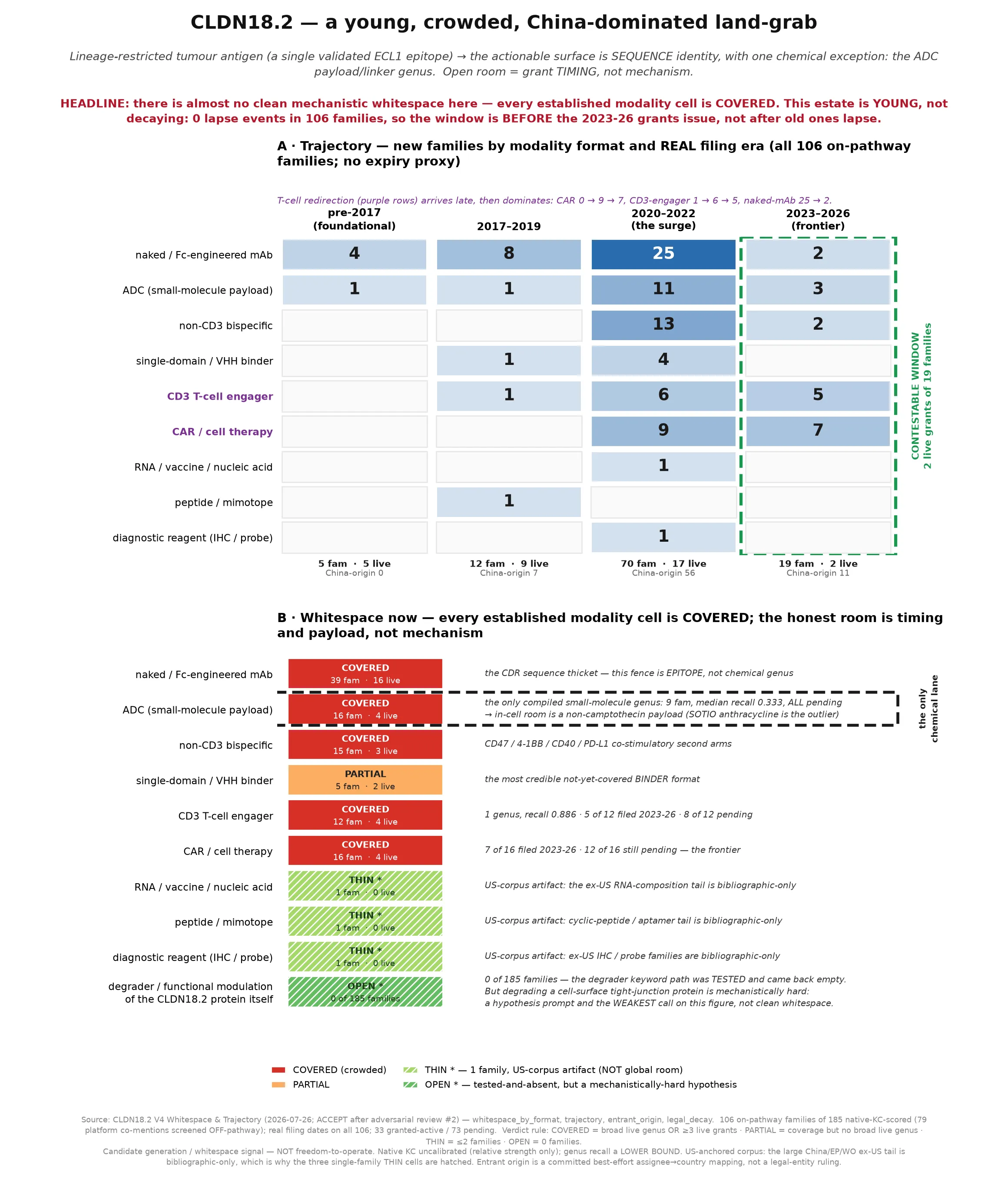
What the map shows, and what a heatmap conveys better than any table, is that the defensible room on claudin-18.2 is narrow and specific. It is a differentiated antibody-drug-conjugate payload lane — the field has crowded onto one chemical class of payload, leaving other chemotypes thinner. It is the still-pending redirection frontier, contestable in the window before those grants issue. It is the least-saturated binder format. None of these are new-mechanism whitespace; all of them are precise, structural, and time-sensitive reads.
That reading was finished on July 26. On July 27, AstraZeneca reported that sonesitatug vedotin had produced a statistically significant improvement in overall survival in second- and later-line claudin-18.2-positive gastric and gastroesophageal-junction cancer in the Phase III CLARITY-Gastric01 trial — the first anti-claudin-18.2 antibody-drug conjugate to do so, at an expression threshold of 25% of tumor cells, which AstraZeneca puts at roughly 60% of patients in that setting. The co-primary progression-free-survival endpoint showed a trend and did not reach significance. It is an important result for the target class, and it is worth being precise about what it does and does not do to the map.
It corroborates the map in three places. The payload is monomethyl auristatin E — off the camptothecin and topoisomerase-I chemotype that seven of the nine genus-bearing claudin-18.2 conjugate families sit on, which is the crowded-payload observation the heatmap makes. The molecule reached AstraZeneca by licence in 2023 from KYM Biosciences, a Chinese joint venture of Keymed Biosciences and Lepu Biopharma, and is now being read out and submitted under FDA jurisdiction — Wong’s structural point in worked form. And in the United States-anchored record the originator’s claudin-18.2 estate is still entirely pending; the four live antibody-drug-conjugate grants on this target belong to other filers. The first Phase III win in the class arrived ahead of its own grants. What the result does not do is redraw the map.
And here is the point that matters for the policy question: none of them move because of who books the value. A restriction on licensing changes which company profits from developing a claudin-18.2 asset. It does not change where the un-claimed structural room sits, or which cells are consolidating, or how much analog space a given genus actually fences. The whitespace map is invariant to the identity of the licensee.
This is worth dwelling on because it is precisely the confusion the policy debate invites. The manufacturing-security argument and the innovation-leadership argument are aimed at different vulnerabilities, and the patent record keeps them separate. If the concern is supply-chain control, that is a question about factories, and it is largely already addressed in these deals by the standard condition that ex-China manufacturing and IP enforcement pass to the Western licensee. If the concern is who owns the durable competitive position in a target class, that is a question about claims — about coverage, whitespace, and trajectory — and it is answerable structurally, deal or no deal. Reading the two as one object produces a policy that addresses neither, and it produces diligence that mistakes a deal headline for a competitive assessment.
The seventh article distinguished the field from the foundation — the observation that being crowded with Chinese filers is not the same as the analytical center of a target sitting in Chinese hands. This article extends that distinction forward in time. The competitive question on a China-heavy target is not answered by the licensing statistics, however striking, and it is not answered by licensing restriction, however it lands. It is answered by reading the structural record of the target itself: where the coverage is dense, where the room is genuinely open, and — on a young, consolidating field like claudin-18.2 — how much time remains before the pending frontier becomes the granted one.
The deals kept coming through the geopolitical headwind because the thing the licensees are buying is not the thing the restriction is aimed at. One is a factory; the other is a claim. A ship makes way through a headwind by trimming to it, not by waiting for the wind to change — and the chart of the coastline does not redraw itself because the weather turned. The BD&L professional valuing the next claudin-18.2 alliance still has to read the chart.